


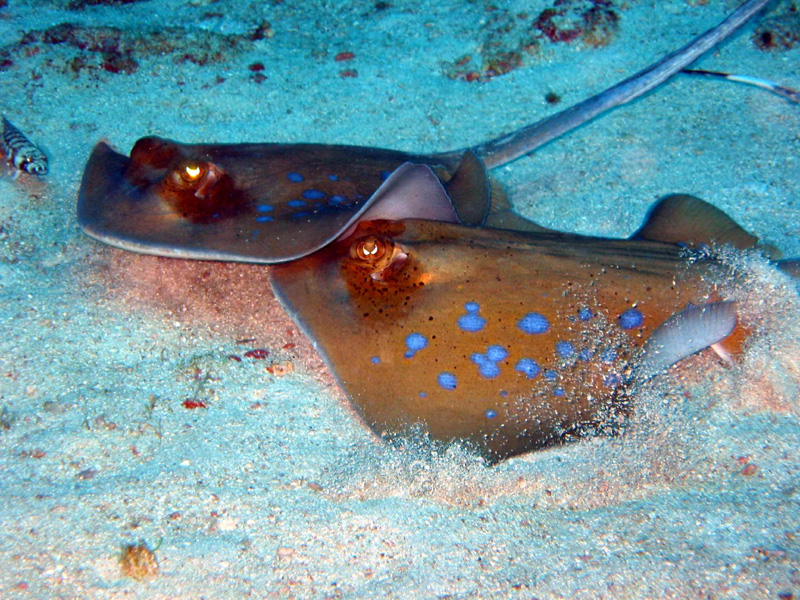
Blue-Spotted Stingray
Scientific name Taeniura lymma
The Blue-Spotted Stingray is one of the most beautiful and instantly recognisable rays found around Koh Tao. Growing up to around 35 cm across the disc (with a tail much longer than the body), they are easily identified by their vivid electric-blue spots scattered across a sandy-yellow to olive body.
They are usually seen resting on sandy patches between coral bommies, partially covered in sand for camouflage. At the approach of a diver, they may remain perfectly still — or suddenly glide away in a smooth, effortless motion, wings rippling as they disappear across the seabed.
Unlike larger pelagic rays, Blue-Spotted Stingrays are reef-associated and tend to stay within relatively small territories. They are most active at night, when they hunt across sandy areas and reef edges.
Blue-Spotted Stingrays play an important ecological role as benthic predators, feeding on small fish, shrimp, crabs and other invertebrates hidden beneath the sand. By disturbing the substrate while feeding, they help recycle nutrients and aerate the seabed.
They are not aggressive toward divers. The venomous spine on their tail is purely defensive and used only if threatened or stepped on. With good buoyancy and awareness — especially in shallow sandy areas — encounters are calm and completely safe.
Seeing one lift off the sand and glide silently across the reef is one of those classic tropical diving moments — graceful, colourful and unmistakably wild.
Find Blue-Spotted Stingray at...
Divemaster's tip
When crossing sandy patches, slow down and scan carefully, and over the reef look under small low rocky overhangs. Look for the outline of a disc shape or a pair of raised eyes sticking out and almost neon blue spots.
Maintain neutral buoyancy and avoid sudden movements. If startled, they’ll usually glide away calmly rather than bolt in panic.
What do they eat?
Blue-Spotted Stingrays feed on small fish, shrimp, crabs and other invertebrates buried in the sand. They use electroreceptors to detect prey hidden beneath the surface, then flap their wings to uncover it before striking.
They are primarily nocturnal hunters, so night dives around Koh Tao often reveal more active behaviour compared to their relaxed daytime resting state.
