


Eagle Ray
Scientific name Aetobatus ocellatus
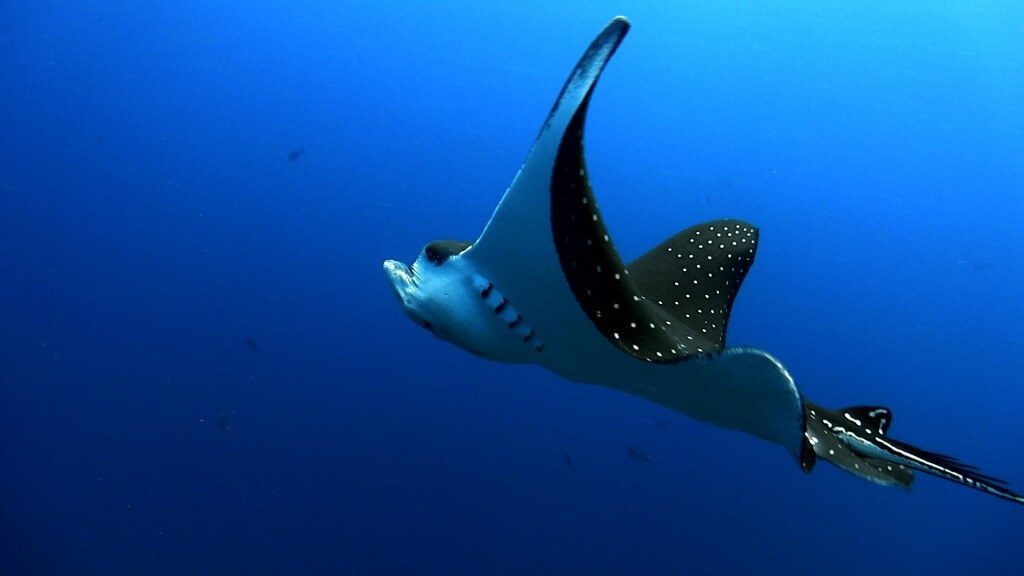
The Eagle Ray is one of the most graceful and awe-inspiring rays you can encounter around Koh Tao. With a wingspan reaching up to 3 metres and a long trailing tail, they move through the water with slow, powerful wingbeats that look more like flight than swimming.
The Indo-Pacific Spotted Eagle Ray is dark above with bright white spots scattered across its back and a clean white underside. Its distinctive pointed snout and long whip-like tail make it unmistakable in silhouette.
Unlike reef-dwelling stingrays, Eagle Rays are often seen cruising mid-water or along current lines at offshore pinnacles. They may appear alone, in pairs or occasionally in small groups, gliding effortlessly past divers before fading back into the blue.
Eagle Rays play an important ecological role as mobile predators, feeding mainly on molluscs, crustaceans and bottom-dwelling invertebrates. Their strong jaws are specially adapted to crush hard shells. By feeding across large areas, they help maintain balance in sandy and reef-edge ecosystems.
They are completely harmless to divers. Though they carry a defensive spine on their tail, they are shy and typically keep a comfortable distance. Most sightings are brief and magical — a quiet fly-by rather than a prolonged encounter.
Seeing an Eagle Ray underwater feels like witnessing something truly wild — elegant, powerful and perfectly at home in open water.
Find Eagle Ray at...
Divemaster's tip
Keep your eyes in the blue — especially during safety stops or when hanging slightly off the reef at offshore pinnacles. Eagle Rays often approach from deeper water or along current edges.
If you see one, stay calm and avoid chasing. Maintain your depth and let them pass naturally — sudden movement usually sends them gliding away faster.
What do they eat?
Eagle Rays feed mainly on crabs, clams, snails and other hard-shelled invertebrates buried in sand. They use electroreceptors to detect prey beneath the surface and powerful jaws to crush shells.
Their wide-ranging behaviour means they cover large areas of reef and sandy bottom, contributing to ecosystem balance across Koh Tao’s dive sites.
