


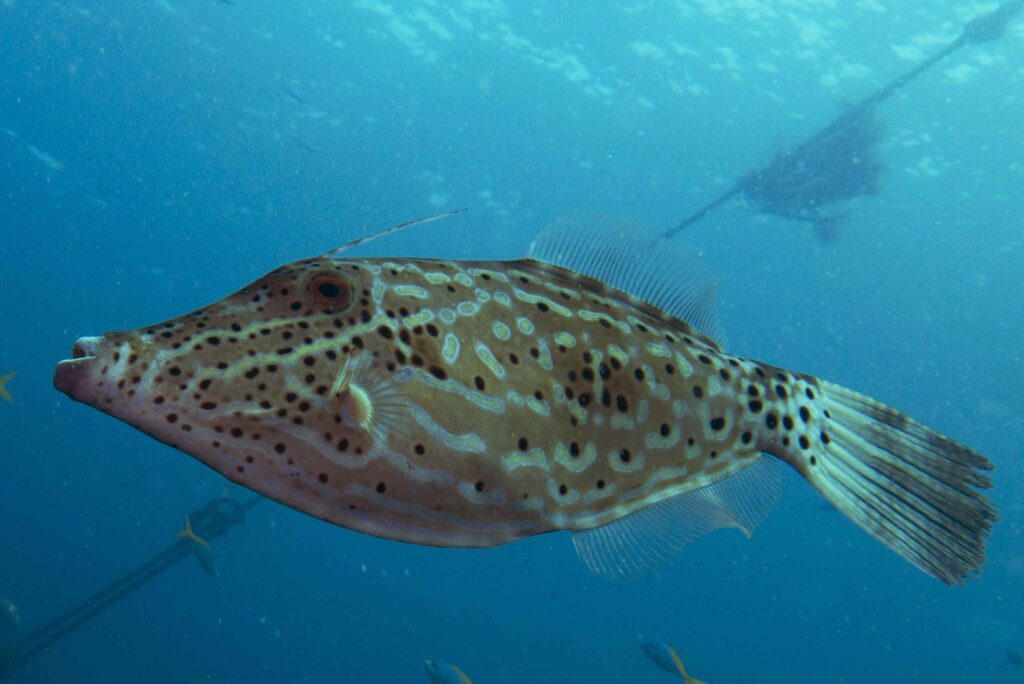
Scribbled Filefish
Scientific name Aluterus scriptus
The Scribbled Filefish is one of the most elegant and unusual-looking fish you’ll encounter around Koh Tao. Growing up to 1 metre in length, they have a tall, laterally compressed body, long flowing fins and delicate blue “scribble” patterns across a pale background — giving them their artistic name.
Adults are typically soft grey, olive or tan with fine electric-blue lines tracing their bodies. Juveniles look completely different — bright yellow with bold black markings — often drifting near floating debris or shallow reef edges.
They move slowly and gracefully, using gentle fin undulations rather than powerful tail beats. Unlike more nervous reef fish, Scribbled Filefish often appear calm and unhurried, sometimes allowing divers to approach fairly closely.
Around Koh Tao, they’re usually spotted cruising along reef slopes, hovering near bommies or occasionally drifting in mid-water. They’re not a guaranteed sighting, but they’re regular enough that sharp-eyed divers are often rewarded.
Scribbled Filefish play a role as reef browsers, feeding on algae, soft corals, tunicates and small invertebrates. Their specialised teeth allow them to nibble selectively at reef surfaces.
They are completely harmless to divers. Their gentle movement and unusual shape make them a favourite for underwater photographers — especially when the blue patterns catch the light.
A sighting feels slightly surreal — like watching a piece of abstract art glide through the reef.
Find Scribbled Filefish at...
Divemaster's tip
Scan mid-water as well as the reef itself. Scribbled Filefish often hover slightly off the structure rather than tight against coral.
If you see one, approach slowly and maintain calm finning — they’re curious but easily spooked by sudden movements. Juveniles may be found near floating objects or shallow reef edges.
What do they eat?
Scribbled Filefish feed on algae, soft corals, sponges, tunicates and small invertebrates. They use small, strong teeth to graze carefully along reef surfaces.
Their browsing behaviour helps control algae growth and contributes to maintaining reef balance around Koh Tao.
