


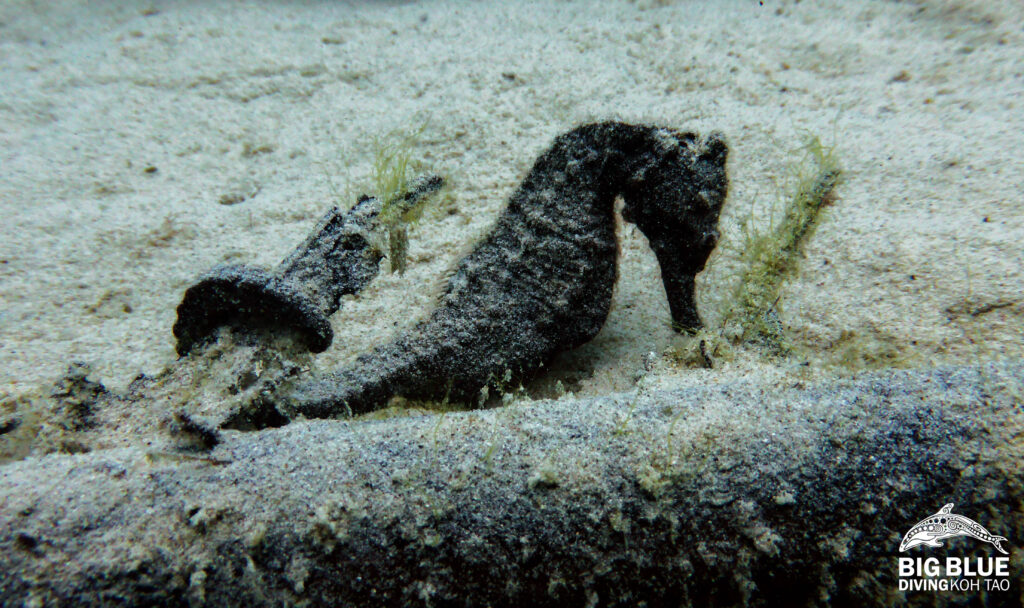
Seahorse
Scientific name Hippocampus kuda
Seahorses are among the most magical and delicate creatures you can encounter underwater. With their horse-shaped head, curled prehensile tail and upright posture, they look almost mythical — yet they’re perfectly adapted reef fish.
Around Koh Tao, sightings are rare and special. They’re usually found clinging to soft corals, sea whips or sponges, gripping tightly with their tail to avoid being swept away by currents. Their colours can vary from yellow and brown to dark mottled tones, often matching their surroundings for camouflage.
Seahorses are slow swimmers, relying on tiny dorsal fin movements to propel themselves. Instead of chasing prey, they ambush small crustaceans by sucking them in through their tubular snout with remarkable speed.
One of their most fascinating traits? The males carry the babies. During reproduction, the female deposits eggs into the male’s brood pouch, where he fertilises and incubates them before giving birth to fully formed miniature seahorses.
They are vulnerable to habitat loss, pollution and collection, making healthy reef environments essential for their survival. Spotting one is always a privilege — and a reminder of how intricate reef life can be.
Find Seahorse at...
Divemaster's tip
Look carefully along sea whips, gorgonians and sponges between 5–20 metres. Move slowly and control your buoyancy — seahorses are easily stressed by strong fin kicks or bubbles too close to them.
Never touch or manipulate their holdfast. Responsible observation ensures they remain in place for future divers to appreciate.
What do they eat?
Seahorses feed on tiny shrimp and planktonic crustaceans. They hunt by stealth, blending in before snapping prey up with a quick suction motion.
Their slow movement means they rely on patience and camouflage rather than speed — a perfect example of reef adaptation at its finest.
