


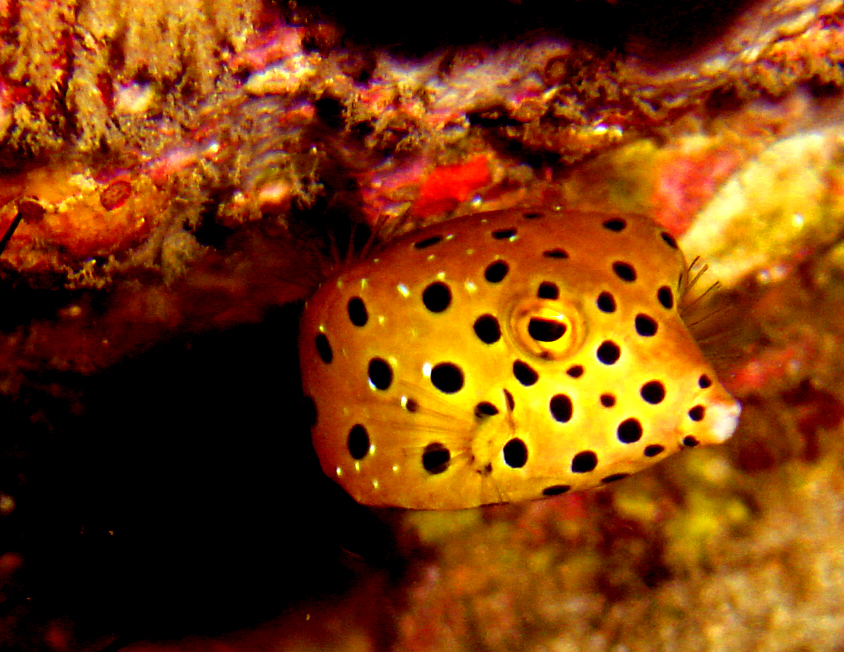
Boxfish
Scientific name Ostracion cubicus
The Yellow Boxfish is one of the reef’s most instantly recognisable characters. With its bright yellow body and neat black polka dots (especially as a juvenile), it looks almost cartoon-like — a tiny floating cube drifting through the coral.
Juveniles are vivid yellow with bold black spots, while adults become more muted — shifting to olive-yellow or brownish tones with paler markings. Their rigid, box-shaped body is formed by a fused bony structure, giving them their distinctive cubic appearance.
They swim using rapid fluttering movements of their small fins rather than their tail, creating a hovering, almost clumsy-looking motion. But don’t be fooled — they’re surprisingly precise navigators around coral heads and bommies.
Around Koh Tao, Yellow Boxfish are usually seen on shallow reefs, often alone and close to structure. They tend to stay within a small territory and can sometimes be observed calmly feeding along coral surfaces.
Yellow Boxfish play a role as reef grazers, feeding on algae, small invertebrates, sponges and crustaceans. Like other boxfish, they possess a chemical defence — if severely stressed, they can release toxins into the water to deter predators. This is extremely rare in the wild and only occurs under significant threat.
They are completely harmless to divers and often allow a close, slow approach. A juvenile Yellow Boxfish sighting is a favourite moment for new divers — colourful, quirky and unmistakably tropical.
Find Boxfish at...
Divemaster's tip
Move slowly and avoid sudden fin kicks — boxfish are easily startled but will often resume feeding if you stay calm. Juveniles are commonly found around shallow coral heads between 3–12 metres.
Keep an eye on small bommies and sheltered reef sections — their bright colour often stands out against coral backgrounds.
What do they eat?
Yellow Boxfish feed on algae, sponges, small crustaceans and other tiny invertebrates. They use small, protruding mouths to pick carefully at reef surfaces.
Their slow, methodical feeding helps control algae growth and contributes to the overall balance of Koh Tao’s shallow reef ecosystems.
