


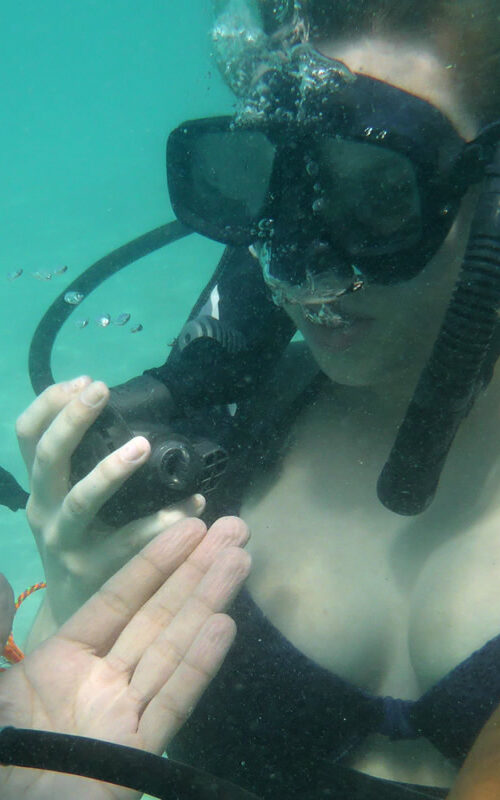
As simple as diving is (kick legs, breathe and look at fish), when you learn to scuba dive it’s very common for our fresh new Open Water students to encounter a problem or two when first trying out all of the new equipment involved in the shallow waters of the first day.
With years of experience dealing with these challenges, we’ve come up with our Top 4 ‘Hardest’ skills of the Open Water Course right here:
1. Breathing out of your Nose-
As I said earlier when you learn to scuba dive its really pretty simple, and it’s often the things that seem most straightforward that people trip up on. It therefore comes as no surprise that a surprising amount of students (for reasons unbeknownst to many) get stuck on the uncomplicated task of blowing air out of their nose. Breathe in through your mouth, out through your nose – easy eh? Well, apparently not! From just simply not exhaling at all, or breathing in instead of out, or my personal favorite of blowing out of your mouth (and then arguing that they didn’t) it’s one of the essential things for all scuba divers to master, as all you certified divers know this is how we get rid of any water that may have collected in our masks.
So what’s the best way to get through this terrible ordeal? It’s here when the quality of your instructor shines through, and usually with a few reassuring words, a quick cuddle and a pat on the head the students are all happily blowing all sorts of muck out of their noses without even realizing it. It also helps to reassure yourself when feeling anxious in a situation like this, tell yourself ‘don’t panic, you can do this’ and more often than not the perceived problem is overcome easily!
2. Mask Clearing-
Ask any dive professional about problems encountered during mask clearing practice and they will no doubt talk of terror, blind panic, and bolting to the surface to get that damn mask off as soon as humanly possible. It’s a vital skill to be mastered when you first learn to scuba dive as it is quite common for water to enter the mask due to a variety of reasons, be it because of a poorly fitting mask, a stray hair caught under the skirting, a kick from another diver or a broken mask strap – the list is endless!
So how do we perfect this technique? The easy answer is to practice as much as possible, preferably first in a training pool! A safe, controlled environment free of boat traffic, current or visibility issues means when you first learn to scuba dive you can feel as comfortable as possible without outside factors causing more stress, and with a few choice words and expert advice from a good instructor the student, before long, is taking the mask of like a true pro.
Ultimately, a flooded mask is a common occurrence underwater, and dealing with it shouldn’t be perceived as an emergency, but rather as a normal part of scuba diving for the competent, confident diver.
3. Setting up the Dive Equipment-
I remember very well indeed the first time I was shown all of the fancy new equipment needed for diving – ‘there’s quite a lot of it’ was my initial reaction, then suddenly I was bombarded with terms like first stage, buoyancy control device (!), second stage, low pressure inflator, primary and alternate…and my confidence dropped to an all-time low. There was no way I’d remember all those names and which was which!
Of course, I did in fact get to grips with the equipment after all, and before long it was almost second-nature to go through the set-up efficiently in a matter of minutes.
So what was it that helped me conquer this fear of long-winded technical terms and unknown equipment? Repetition was absolutely the key. Again and again we set up the dive equipment, take it apart, set it up, swap with our buddy’s equipment…. repeat ad nauseum! It didn’t take many dives before we could do it with our eyes closed, had worked out the exact knack of getting that LPI connected in one easy movement, and had become at one with the equipment.
The trick is to keep at it, and when diving after the completion of your Open Water insist on always setting up your own equipment to ensure you don’t forget how – after all who better to trust with your stuff than yourself!
4. Deep Water Entry-
This is a strange one, as the deep water entry is basically hold the belt, hold the mask and step in. So why do we always have a bit of bother with this one? It all really comes down to two emotions – excitement and fear. The first time out on the boat, with everyone putting on their equipment for the first training dive of the SSI or PADI Open Water, is a great place to get excited. There’s always a wonderful buzz going around the boat as we head to the dive site, and when the captain honks his horn to give the all-clear to jump in you can see the visible change in our divers demeanour, usually an even split of the nervous and the bloody excited!
Herein lies the problem with the deep water entry. Our divers head to the back of the boat, instructions are repeated for the final time, the diver holds the belt and mask and steps into the unknown… It’s at this point when at least one person from every group of divers will let go of whatever they were holding and either flap their hands around nervously like they’re a chicken whilst stepping into the ocean, or does some super-excited hands-in-the-air star-jump thingamabob, usually accompanied by a few laughs from the other students. No matter how cool and collected the diver may have seemed before their giant leap for mankind, you can be assured that there will always be, from now until the end of time, at least one who royally screws it up and forgets everything they were told a matter of seconds before.
How to beat this? Vulcan emotion-suppressing aside, closing your eyes and taking a few deep breaths to calm yourself should be enough, but there will always be at least one remember…
