


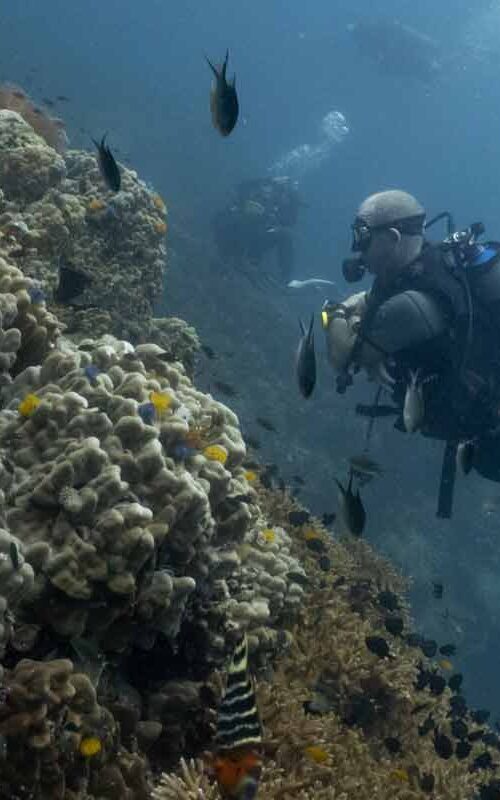
What you don’t know before learning to dive is that peak performance buoyancy is the most important skill a scuba dive can master! Learning scuba diving is a process of getting to grips with a number of different elements- physical dexterity and spatial awareness (i.e. not banging into other divers or coral), physics (buoyancy), engineering (fixing your own equipment), and differing levels of OCD (washing your own equipment properly).
Diving is about Peak Performance Buoyancy
It’s a combination of theory lessons in the restaurant or classroom, and practical sessions, starting in the pool and ending in the ocean. At Big Blue, we completely understand that the last thing anyone would want to do is to go on holiday and end up being bored to death about physics in a classroom. So we’re very good at teaching you the information that you need to digest and understand in order to improve your diving, but without waffling on forever.
Buoyancy Control
One of the most important elements of diving is buoyancy. It’s pretty easy to get your head around, people have an instinctive understanding of it, even though they don’t know it at first. The key to improving buoyancy is by practicing it whilst diving. Remember your first driving lesson and how you probably stalled the car a few times before you were able to actually get going? Buoyancy is no different, but instead of having dual controls, we get you to feel and practice the feeling of changing buoyancy in the safe confines of a pool.
Here’s the basic principle.
When you jump in the water off a dive boat, you need to be what we call positively buoyant. This means that you will float along without having to kick like crazy to keep your head out of the water with all your equipment on. You achieve positive buoyancy by putting air into the jacket that you wear, called a BC, that also holds your cylinder of air. Now, when you want to go underwater you need to let all that air out so you will sink as you head down the descent line- this is called negative buoyancy. To stop you sinking all the way to the sea bed, you need to put little bits of air in your BC so that you will float along at the same level. This is called neutral buoyancy and it’s neutral buoyancy that we want to achieve when we are swimming along underwater. If you kick up just a little bit, the air in your BC will expand slightly, and make you want to go up to the surface. You want to stay down underwater so you need to let a little bit of that air out of your BC to remain at the same depth. If you can get your head around that, you will be a good diver very quickly.
At the end of your dive
The most counter-intuitive thing about diving is when you want to go to the surface and end your dive. Most people think that you add air into your BC to go up, after all, that’s going to make you float up. The problem is if you do add air, you’ll go to the surface way too quickly, and we always want to ascend nice and slow and controlled. So to end the dive we periodically let the air out of the BC as we swim up. That way, we are in control instead of our BC full of air taking us up. You don’t have to let all the air out straight away, but instead, vent air as you feel your BC taking charge of your ascent. As soon as your head is out of the water, then you can fill your BC with air and be a positively buoyant cork again. Easy eh?
Your instructor will take as long as you need to help you get to grips with it all, and the good news is that once you understand it, it becomes automatic so you can concentrate on enjoying what you see underwater.
Make sure when you enroll in your Advanced Course that your choose the Peak Performance Buoyancy dive as one of your 5 dives. You will be amazed how much you learn here and how it will help you in all aspects of your diving including the rate at which you breathe your air.
