


Once you start diving, it becomes very hard to stop – ask any dive pro here on Koh Tao and they’ll usually tell you the same story, they came for a few days and before they knew it they’d signed up for professional training and waved goodbye to the grind of the real world and the 9-5.
As you start buying equipment and learn more about diving through PADI/SSI courses, you’ll find that doing some proper research on what you’re intending to buy will help get you ready for years of diving enjoyment. One key component in your gear is your dive computer, and in this blog we’ll be looking at my 3 favourite computers on the market right now:
Shearwater Research Petrel 2
The largest dive computer to make my top three, the Shearwater Petrel 2 is one hell of a dive computer and my undoubted number one choice for those with a bit of cash to splash on a proper dive computer!
It features a large full size 2.4 inch screen that allows you to see all the important functions (depth, temperature etc.) without having to scroll through several screens – making it a lot easier for those diving in cold waters and wearing gloves, which is always a struggle with the small-buttoned models. It supports both normal regulators and rebreathers, as well as Trimix diving making it an excellent choice for recreational and technical divers alike – purchasers can be sure that they’ll never need to buy another dive computer again with this beauty, and even if you are a beginner diver this will be a good investment as you will never outgrow it, no matter what your future diving tastes.
The backlight on the Shearwater Petrel 2 is adjustable and on medium brightness with a single AA alkaline battery you will get about 35 hours of life, and if you use a SAFT LS14500 lithium you can get over 100 hours! I love the fact a normal AA battery can be used with this, it really cuts the chance of having a dive trip ruined by a flat battery. It also features an incredibly clear screen, with a lovely bright LCD display rather than the older crystal displays that so many of the other popular dive computers feature.
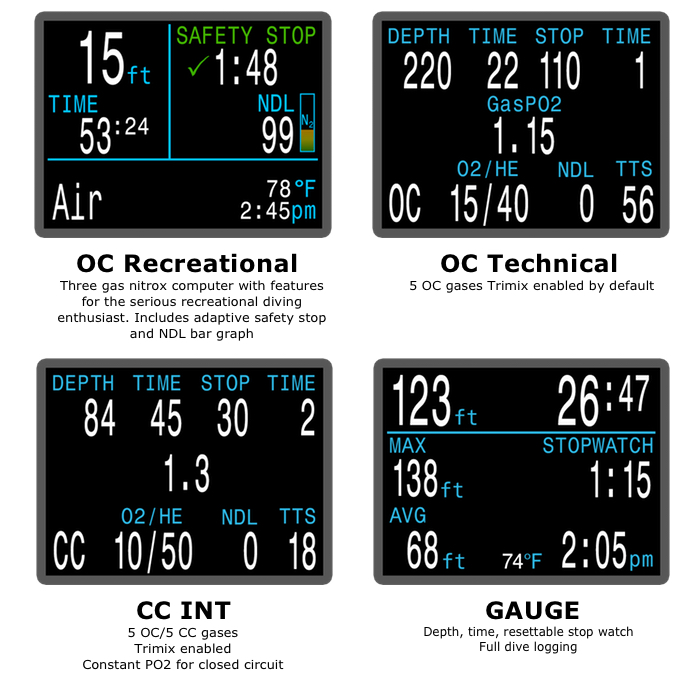
You can also customize the layout of all the essential info to suit your dive style and I’m a huge fan of the ‘time to surface’ feature, which actually calculates how many minutes it will take you to surface if you started your ascent at that very moment, including decompression and safety stops.
The digital compass included in the Shearwater Petrel 2 is one of the best I on the market. It is tilt compensated so reads properly at any angle, has a degree wheel displayed which you can toggle between 60, 90 and 120 degree display modes, and best of all you can easily mark a heading and it automatically marks the reciprocal heading for finding your way back – perfect for stupid DMTs!
Like most of the good computers available these days, the Petrel 2 can link via Bluetooth easily to communicate with your PC, Mac, iPod or iPad.
So, don’t let the size or price put you off – it retails at around $850 US – as you can be certain that this surprisingly easy to use dive computer will have other divers drooling over it on the boat and underwater. For anyone thinking about getting into technical diving then there’s really no better computer on the market that the Petrel 2, and with its sturdy design you can tell immediately that it’s a dive computer made to last for a very long time indeed.
The best dive computer I’ve ever seen, hands down.
Specifications
Air/Nitrox/Trimix capable
Screen Resolution 320×240 QVGA
Full colour LED LCD
Battery Type – Single AA
3 axis, tilt compensated, digital compass
Dive Log 1000 Hours
Smart Ready Bluetooth Interface
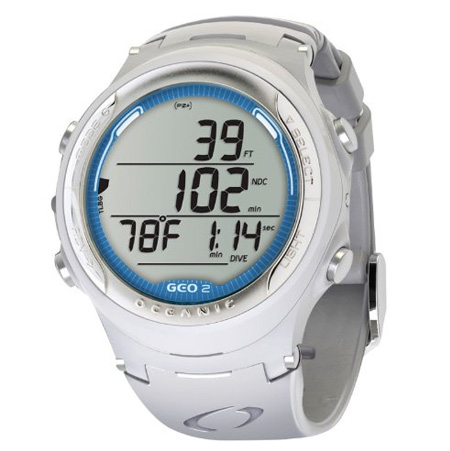
Oceanic Geo 2.0
A great example of a mid-range dive computer, the Geo 2 is one I’ve been wanting for a long time now. With its nicely designed screen and easy to read numerical displays, its small ‘watch’ size doesn’t mean it’s lacking in features at all.
The Oceanic Geo 2 Supports both air and 2 programmable nitrox gas mixes, one up to 100% O2 which is pretty unusual in similar computers. The audio alarms are loud enough but not annoyingly so, and they’re also accompanied by a very handy small flashing LED for the hard of hearing out there.
The Oceanic Geo 2 dive computer features four operating modes: Watch, Norm (for air and nitrox), Gauge (with run timer) and a free diving mode, which is nice. Despite the instruction manual being a little confusing the computer is really easy to get the hang of after a few minutes messing around with it, and the pretty powerful backlight (with adjustable duration) works great. Like many of its competitors it too comes with a safety stop countdown timer.

I really like that it has an easy access ‘last dive’ function for quick reference, and of course you can see it is a cool design which doesn’t look out of place at all out of the diving environment. Another great bonus is that you’re able to change the battery yourself in a matter of minutes, saving a lot of time and money when it does get a little low on power.
Finally, and one of the most important features for a lot of experienced divers is that it’s possible to change the algorithm used to calculate your NDLs! They offer dual algorithms allowing to switch between them when necessary, which is particularly handy if you dive with a buddy that has his own computer which calculates based on a specific model. You at least will be able to somewhat get the calculations in sync!
The algorithm you can select is either the Buhlmann ZHL-16c based PZ+ or a DSAT based model. The DSAT variant is better suited when you want to pick a liberal recreational dive algorithm, whereas the Buhlmann algorithm is more conservative. It’s also possible to adjust the conservatism of either of the calculation models by yourself to achieve a more conservative dive profile.
Overall this is one of the best dive computers in the intermediate price range on the market today, and if it featured a digital compass it could well be sitting pretty in my number one spot. It retails at around $350 US.
Specifications
Easy to navigate with 4 buttons
Four operational modes for Watch, Air/Nitrox, Gauge and Free Diving
Two gas mixes between 21% and 100%
PO2 limits adjustable from 1.2 to 1.6 bars
Two different algorithms with additional conservatism settings
Max. operating depth 100 meters for Air/Nitrox and 120 meters for Gauge
Automatic altitude adjustments up to 4,270 m (14,000 ft)
Dive log with capacity for 24 dives
Log sampling rates selectable at 2, 15, 30 and 60 seconds
User switchable battery
Limited warranty of 2 years
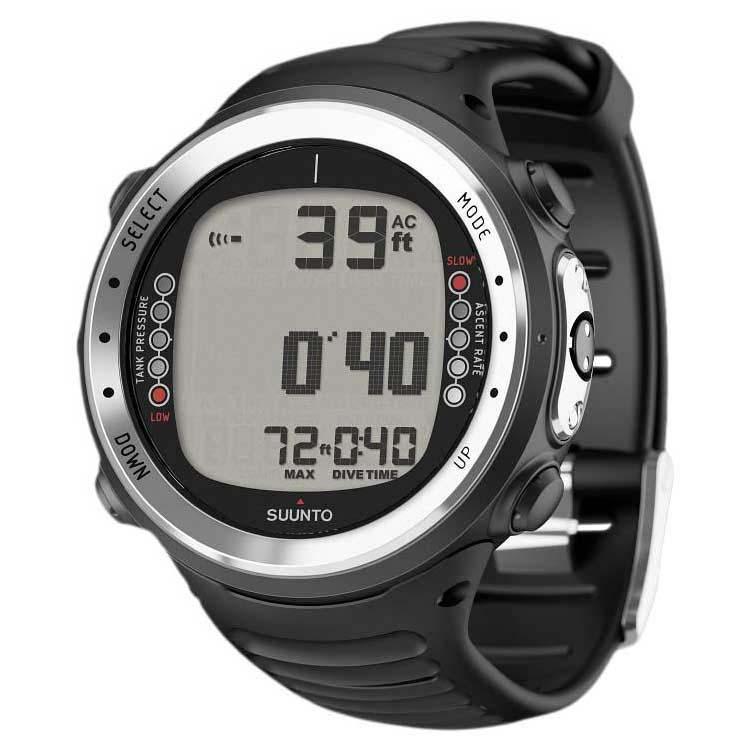
Suunto D4i
The Suunto dive computer is a very popular brand, and the D4i is easily the most commonly seen dive computer in my recreational diving experiences around the world – meaning there’s almost always someone who can help you with it if you didn’t read the instruction booklet properly!
It’s a sleek, compact and lightweight dive computer that can easily be worn everyday as a watch, and has four dive modes: Air, Nitrox, Freedive and Gauge. The Suunto D4i also comes with the ability to connect to an (optional) wireless air transmitter which makes it great for mid-level divers who want the ability to expand their gear later on.
The freediving mode stands out and you can see why this a very popular computer with our freediving team, mainly due to its ease of use, small size and also the ‘3 times a second’ sample rate, giving you highly accurate data on the true depths reached on your dives.
The Suunto D4i comes with an 80 hour internal dive log that can be easily exported to your PC for digital dive log enthusiasts, and the dot matrix display is super easy to read and has a strong backlight that keeps all essential dive information available at a quick glance – an essential characteristic for those looking to buy a compact watch-style computer.
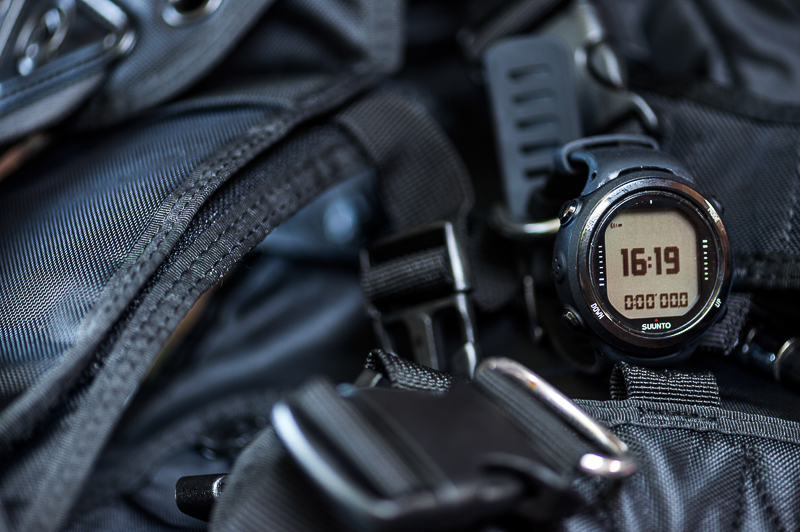
There is a nice safety stop countdown feature, and the nitrox settings can be adjusted between 21% and 50% without much trouble at all. The optional wireless air integration on the D4i allows you to easily track current tank pressure and remaining air time with a quick glance at your wrist, along with other critical information, giving you more time to truly enjoy your dive.
I highly recommend this to scuba diving enthusiasts looking for a high quality mid-range Suunto dive computer. The free diving mode is great, and the optional wireless air integration feature is a nice touch for those looking to invest in a transmitter.
The Suunto D4i retails at around $450 US.
Specifications
Adjustable alarms for ascent rates and maximum depth and time
Free diving mode sampling depth information 3 times per second
Clear and precise dot matrix display with backlighting
Four dive mode settings including Air, Nitrox, free dive and gauge
Adjustable Nitrox settings between 21% and 50% with PO2 limits between 0.5 and1.6 bars
Maximum depth display to 100 meters
Adjustable Altitude
Built-in dive log up to 140 hours
Lithium battery (CR2450)
RGBM (Reduced Gradient Bubble Model) algorithm
Built-in dive planner
Optional wireless air integration
2 year limited warranty
Happy shopping!
