


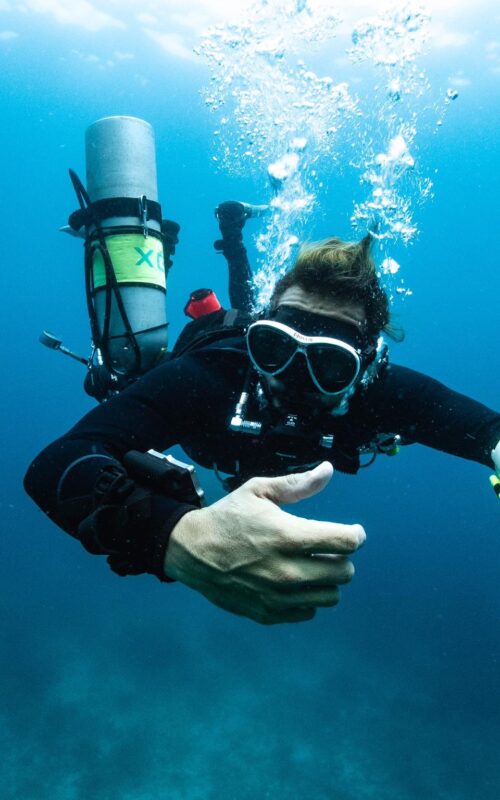
Let me tell you something about recreational diving that nobody mentions in those glossy brochures with the smiling people pointing at turtles: it’s the aquatic equivalent of a gentle stroll through a park. Pleasant, certainly. Relaxing, absolutely. But about as adventurous as choosing between marmalade and strawberry jam at breakfast. Technical diving, on the other hand, is what happens when perfectly sensible human beings look at their standard scuba equipment and think, “You know what this needs? More of everything.” More tanks, more depth, more complexity, and considerably more ways to realize you should have paid better attention during the briefing.
And nowhere does this particular brand of underwater madness reach more glorious heights than on Koh Tao, Thailand’s diminutive diving mecca, where Big Blue Tech has established itself as the finishing school for divers who’ve grown tired of the shallow end.
Why Koh Tao for Technical Diving?
Koh Tao (which translates to “Turtle Island,” though you’re more likely to encounter technical divers than turtles these days) has become the technical diving capital of Southeast Asia. The island offers warm waters, excellent visibility, challenging dive sites, and most importantly, dive centers that understand the difference between “advanced” and “clinically insane.”
Big Blue Tech stands at the forefront of technical diving training on Koh Tao, offering everything from your first tentative steps into twinset configuration to the sort of wreck penetration courses that make your mother wonder where she went wrong.
The Technical Diving Courses: A Gentleman’s Guide to Controlled Drowning Prevention
Twinset Diving: Because One Tank is for Amateurs
The twinset diving course is where most technical divers begin their journey into complexity. Picture this: instead of one perfectly adequate tank on your back, you now have two, connected by a manifold system that would make a plumber weep with joy.
What It Entails:
The twinset course teaches you to manage doubles configuration, master valve shutdown procedures (critical when one of your tanks decides to have a catastrophic failure), and develop the peculiar skill of swimming while carrying what feels like a small refrigerator on your back. You’ll learn redundancy management, gas planning for technical dives, and the art of looking vaguely competent while your arms ache from the additional weight.
How to Get Involved:
Prerequisites typically include Advanced Open Water certification and 50 logged dives minimum. The course runs 3-4 days and includes confined water sessions, open water dives to 30-40 meters, and enough theory to make you question your life choices. Big Blue Tech provides all technical diving equipment, though purchasing your own twinset setup is recommended if you’re serious about technical diving progression.
Sidemount Diving: For Those Who Prefer Their Tanks Alongside Rather Than Behind
Sidemount diving represents the elegant solution to the twinset problem: if tanks are heavy on your back, why not distribute them along your sides like the world’s most cumbersome saddlebags?
What It Entails:
The sidemount specialty course transforms you from a back-mount diver into someone who looks rather like an underwater pack mule, albeit a very streamlined one. You’ll master sidemount configuration, learn to manage multiple cylinders, practice gas switching procedures, and discover the joys of entering caves and wrecks where traditional back-mount divers fear to tread.
Sidemount diving offers unparalleled flexibility, easier tank management, and the ability to navigate restrictions that would stop a twinset diver in their tracks. It’s also easier on your back, which your spine will thank you for around age forty-five.
How to Get Involved:
Open Water certification is the minimum requirement, though many divers come to sidemount after recreational diving experience. The Big Blue Tech sidemount course spans 3-4 days with pool training, open water dives, and configuration workshops. Many technical divers find sidemount diving more comfortable for extended penetration dives and deep technical diving.
Rebreather Diving: Silent Running at Great Depth
If you’ve ever wanted to feel like a space explorer while underwater, rebreather diving is your ticket. Unlike traditional scuba (which wastefully expels perfectly good breathing gas with every exhalation), rebreathers recycle your breath, scrub out the carbon dioxide, add oxygen, and return it for another go.
What It Entails:
Rebreather courses represent the graduate degree of technical diving. You’ll learn closed-circuit rebreather (CCR) operation, oxygen monitoring systems, CO2 scrubber management, and the peculiar skill of troubleshooting complex life-support equipment while underwater. The advantages are remarkable: extended bottom times, reduced decompression obligations, silent operation (fish actually approach you), and the smug satisfaction of using technology that costs more than a used car.
Big Blue Tech offers multiple rebreather courses depending on your unit (they work with various manufacturers including AP Diving, rEvo, and JJ-CCR). Training covers unit-specific operations, bailout procedures, pre-dive checks that take longer than some people’s entire dives, and emergency protocols.
How to Get Involved:
Rebreather diving demands significant experience: typically Advanced Nitrox and Decompression Procedures certifications, plus 50-100 logged dives. The course runs 5-7 days and represents a substantial financial investment (rebreathers cost $8,000-$15,000). However, operational costs decrease over time as you’re not constantly buying tank fills. Big Blue Tech offers try-dives for curious divers considering rebreather training.
Wreck Penetration: Entering Places That Explicitly Didn’t Want You Inside
Wreck penetration diving takes the perfectly reasonable activity of looking at shipwrecks from the outside and asks, “But what if we went in?” It’s rather like the difference between admiring a house from the street and deciding to explore the basement without a torch.
What It Entails:
The wreck penetration course teaches proper penetration techniques, line management, communication in overhead environments, and the critical skill of remembering which way leads back to sunlight and continued existence. You’ll learn to navigate silty conditions, manage equipment in confined spaces, and develop the situational awareness required when exits aren’t immediately obvious.
Koh Tao offers excellent wreck diving sites including the HTMS Sattakut, a 50-meter naval vessel deliberately sunk as a dive site. Big Blue Tech uses these wrecks for realistic training scenarios, teaching proper entry/exit procedures, emergency protocols, and the etiquette of not destroying underwater archaeology.
How to Get Involved:
Advanced Open Water and Deep Diver certifications are prerequisites, along with excellent buoyancy control (you cannot afford to crash into wreck structures). The course includes penetration planning, guideline work in confined environments, silt-out recovery procedures, and multiple wreck dives progressing from simple swim-throughs to complex penetrations. Big Blue Tech’s wreck penetration courses run 3-4 days with emphasis on conservative planning and risk management.
Nitrox and Gas Blending: The Chemistry Set You Actually Want
Nitrox certification might not sound as glamorous as rebreather diving, but it’s the foundation of technical diving. Enriched Air Nitrox (EAN) contains higher oxygen percentages than regular air (typically 32% or 36% instead of 21%), allowing longer bottom times and shorter surface intervals.
What It Entails:
The Nitrox course covers oxygen physiology, oxygen toxicity prevention, maximum operating depths for different nitrox mixes, and the critical skill of analyzing your gas before diving. You’ll learn equivalent air depth calculations, oxygen exposure tracking, and why lying about your gas mix is an excellent way to win a Darwin Award.
Gas blending takes this further, teaching you to create custom breathing gases including nitrox, trimix (helium-based mixes for deep diving), and oxygen-enriched decompression gases. The gas blending course transforms you into an underwater chemist, calculating partial pressures, managing oxygen-clean equipment, and understanding the physics of gas mixing.
How to Get Involved:
Nitrox requires only Open Water certification and can be completed in 1-2 days. It’s the most popular technical diving specialty and highly recommended for all divers planning technical diving progression. Gas blending courses require more advanced certification and run 2-3 days, covering practical blending operations at Big Blue Tech’s dedicated gas blending station.
Big Blue Tech offers both recreational and technical nitrox courses, plus professional-level gas blending training for those considering careers in technical diving instruction.
The Big Blue Tech Advantage
What separates Big Blue Tech from other technical diving centers on Koh Tao (and there are several excellent options) is their comprehensive approach to technical diving education. They offer:
- Experienced Technical Diving Instructors: Staff with thousands of technical dives including cave systems, deep wrecks, and expedition diving
- Complete Technical Diving Equipment: Twinsets, sidemount systems, multiple rebreather units, and stage cylinders
- On-site Gas Blending Facilities: Custom gas mixes including trimix for deep technical diving
- Progressive Training Programs: Structured pathways from first technical diving course through professional technical diving instructor levels
- Warm Water Training Environment: Koh Tao’s tropical conditions mean comfortable learning without drysuits and extreme cold
- Excellent Dive Sites: From Chumphon Pinnacle’s deep walls to the HTMS Sattakut wreck, Koh Tao offers varied technical diving opportunities
Making the Leap: From Recreational to Technical Diving
The transition from recreational to technical diving isn’t for everyone, and that’s perfectly fine. Technical diving demands significant time investment, financial commitment, and genuine passion for underwater exploration. You’ll spend more time planning dives than executing them, carry equipment that resembles a mobile life-support system, and explain to non-divers why you need three computers, seven tanks, and an engineering degree to look at fish.
But for those who make the commitment, technical diving opens underwater realms recreational divers can only imagine: deep wrecks resting beyond recreational limits, cave systems penetrating far beyond daylight zones, and the profound satisfaction of mastering complex skills in an unforgiving environment.
Getting Started with Big Blue Tech
If you’re ready to separate yourself from the recreational diving herd (or at least explore whether technical diving suits you), Big Blue Tech makes starting straightforward:
- Assess Your Experience: Ensure you meet prerequisites for your desired course (typically Advanced Open Water and 50+ dives minimum)
- Contact Big Blue Tech: Their team can recommend appropriate technical diving courses based on your experience and goals
- Plan Your Visit: Koh Tao offers accommodation ranging from budget hostels to comfortable resorts, with technical diving courses typically requiring 3-7 days
- Prepare Physically: Technical diving is more physically demanding than recreational diving; good fitness helps enormously
- Budget Appropriately: Technical diving courses cost more than recreational training, plus equipment purchases if you continue
Final Thoughts: Is Technical Diving Worth It?
Standing on a boat in full technical diving kit—twinset on your back, stage cylinders clipped to your sides, three computers strapped to various appendages—you’ll inevitably wonder if you’ve made sensible life decisions. Then you’ll descend past recreational diving limits, penetrate into spaces few humans ever see, and realize that sometimes the most rewarding experiences require the most ridiculous amounts of equipment.
Technical diving on Koh Tao with Big Blue Tech isn’t just about going deeper or staying longer. It’s about mastering skills that transform you from an underwater tourist into an underwater explorer, capable of accessing places that exist beyond the reach of conventional scuba diving.
So if you’re tired of the shallow end, if you’ve looked at those recreational depth limits as suggestions rather than rules, and if you’re ready to separate yourself from the casual divers (the boys, if you will, though plenty of women excel at technical diving and often with better buoyancy control), then Koh Tao awaits.
Just remember to analyze your gas. Seriously. Every single time.
Ready to Start Your Technical Diving Journey?
Contact Big Blue Tech on Koh Tao to discuss technical diving courses, equipment requirements, and scheduling. Whether you’re interested in twinset diving, sidemount configuration, rebreather training, or wreck penetration, their experienced technical diving instructors can guide your progression from recreational diver to technical diving expert.
The deep awaits. Bring extra cylinders.
