


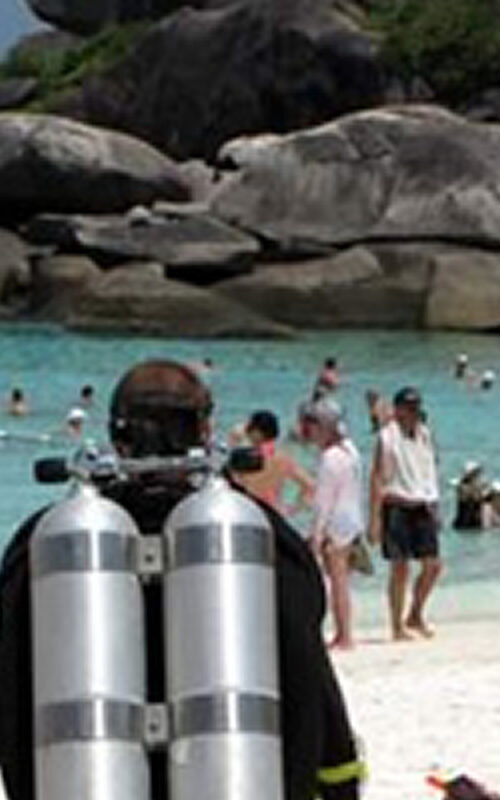
The Extended Range Course that we offer here at Big Blue Tech is for the explorers among you who like a bit of excitement in your lives! There are places in the world that have spectacular dive sites at depths deeper than 40 meters/130 feet, and not many places that have access to Helium. And by becoming an Extended Range Diver this will be how you access these sites?
The Extended Range Course
It teaches you the proper techniques to utilizing compressed air as breathing gas at a maximum depth of 55 meters/180 feet, so you’ll never miss those really deep dives again. The course will provide the training necessary to competently execute dives to this depth that require staged decompression, using nitrox mixtures or oxygen during decompression. A big part of the extended range course is focused on narcosis management. The difference between the effects of gas narcosis at 45 meters and at 55 meters can be considerable, so exposure to depth during the course is fundamental.
Risk management is also rigorously taught in tandem with task loading on training dives. Our instructors will slowly add more and more to your plate underwater so that you get used to having multiple things that require your attention. In the event of an emergency on an extended range dive, this repetitive task loading training is invaluable and will allow you to deal with any issue comfortably.
The Extended Range course is a good alternative for divers that don’t want to deal with the prohibitive costs of diving on Helium mixes. The course is also a good starting point to move into TDI Trimix training.
Pre-requisites
You must be 18 years or older to register for the Extended Range course. You must also have completed the Decompression Procedures course and have proof of at least 100 logged dives, 25 of which need to be deeper than 30 meters/100 feet.
Whats involved?
The Extended Range course takes a look at the following:
History of deep air diving
Physics – Pressure review, formulas for solving dive planning problems, maximum operating depths (MOD), best mix, and more.
Physiology – Hypoxia, oxygen toxicity, nitrogen narcosis, nitrogen absorption and elimination, carbon dioxide toxicity, carbon monoxide, hyperthermia, hypothermia.
Decompression options – Air, Nitrox, oxygen.
Equipment considerations
Dive tables
Dive planning – Operation planning, team planning, emergency planning.
Diving procedures
Descent procedures
Descent considerations
Technical dive support
Navigation
Don’t forget! Because of the extra nitrogen your body builds up while scuba diving, you cannot fly within 24hrs of your last dive.
Starting our next Extended Range Course this Monday 15th June to the 18th June.
Want to join in? Contact us at Big Blue Tech.
