


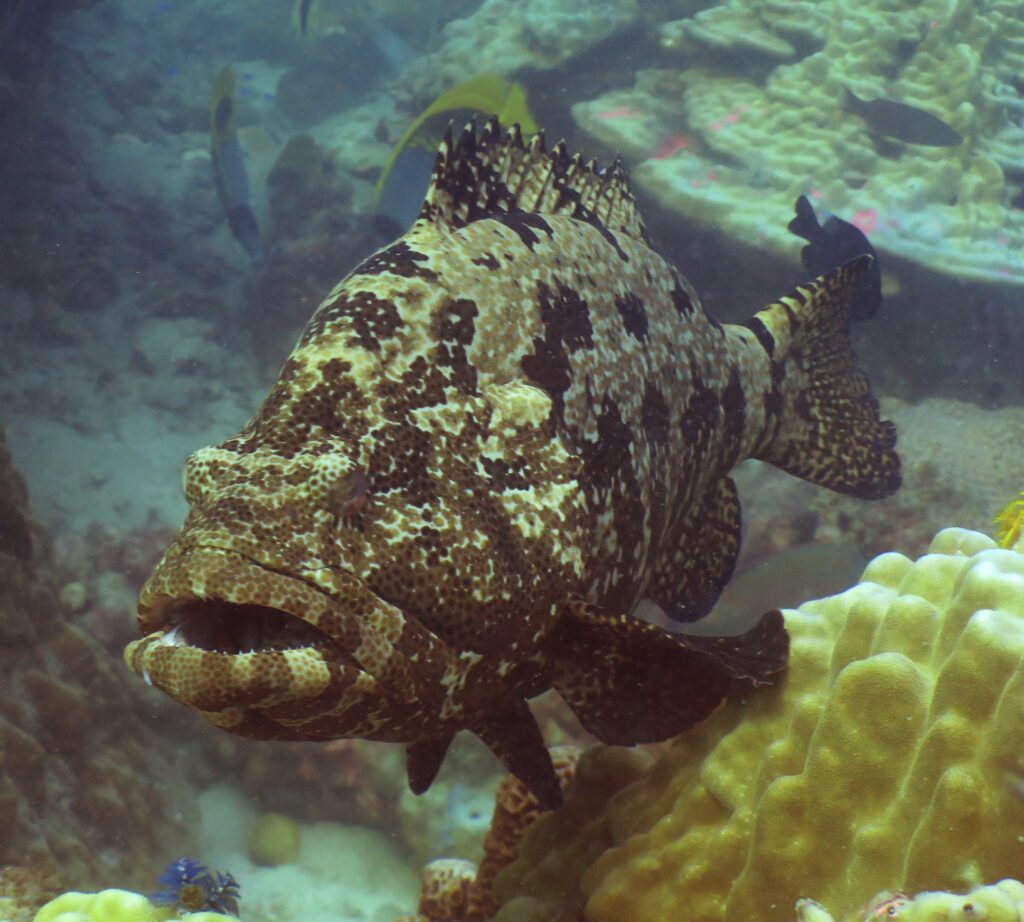
Giant Grouper
Scientific name Epinephelus lanceolatus
The Giant Grouper is the heavyweight champion of the reef — the largest bony reef fish in the world. Growing up to 2.7 metres long and weighing over 400 kg, encountering one underwater is an unforgettable experience.
With a massive head, thick lips and broad body covered in mottled brown and pale blotches, they blend surprisingly well into reef walls and rocky pinnacles despite their size. Their slow, powerful movements and unbothered presence give them an almost prehistoric feel.
Around Koh Tao, sightings are rare but possible at deeper pinnacles and offshore sites. Large individuals tend to patrol reef slopes or hover near caves and overhangs between 15–35 metres. Juveniles may inhabit shallower protected areas before moving offshore as they mature.
Despite their intimidating size, Giant Groupers are generally calm and non-aggressive toward divers. They are curious but cautious, often watching divers from a short distance.
They are apex predators, feeding on fish, crustaceans and occasionally even small sharks or rays. Their powerful suction feeding technique allows them to engulf prey rapidly.
Due to overfishing and slow growth rates, they are considered vulnerable in many regions, making any encounter a special privilege.
The Malabar grouper has a remarkably long life span for a fish. Scientists estimate they can live to be at least 40 years old. It is a protogynous hermaphrodite, which means that females can evolve into males during their lifetime.
Find Giant Grouper at...
Divemaster's tip
Scan large overhangs, caves and deeper reef slopes. Sometimes you’ll see what looks like a shadow — then it moves.
Maintain respectful distance and excellent buoyancy. Their size makes them impressive, but they are sensitive to disturbance.
What do they eat?
Giant Groupers feed on reef fish, octopus, crustaceans and occasionally rays or small sharks.
Using powerful suction, they can engulf prey in a single rapid movement — a reminder that even the calmest-looking reef residents can be formidable predators.
