


Coral bleaching happens when stressed corals lose the microscopic algae that normally live within their tissues, causing the coral to become pale or white. Bleaching does not automatically mean that a coral is dead, but prolonged or severe stress can increase the risk of disease and mortality.
For an island such as Koh Tao, where coral reefs support marine life, tourism and local livelihoods, understanding bleaching matters to residents and visitors alike.
This guide explains what causes coral bleaching in Koh Tao and elsewhere, why some corals recover while others do not, and how people can help reduce avoidable local pressures on reefs.
What Is Coral Bleaching?
Many reef-building corals live in a close relationship with microscopic algae commonly known as zooxanthellae. These algae provide much of the coral’s colour and help supply energy through photosynthesis.
When environmental conditions become stressful, corals can expel those algae. The underlying white skeleton then becomes visible through the coral’s transparent tissue, producing the bleached appearance.
According to the US National Oceanic and Atmospheric Administration, changes in temperature, light or nutrients can trigger bleaching, with unusually warm water being the main driver of mass bleaching events.
Is Bleached Coral Dead?
No. This is one of the most important facts to understand about bleaching.
A bleached coral is stressed, but it may still be alive. If conditions improve before the stress becomes too severe, the coral can regain its symbiotic algae and recover its colour.
If high temperatures or other stressful conditions persist, the coral may become weakened, more vulnerable to disease and eventually die.
Why Ocean Heat Causes Mass Bleaching
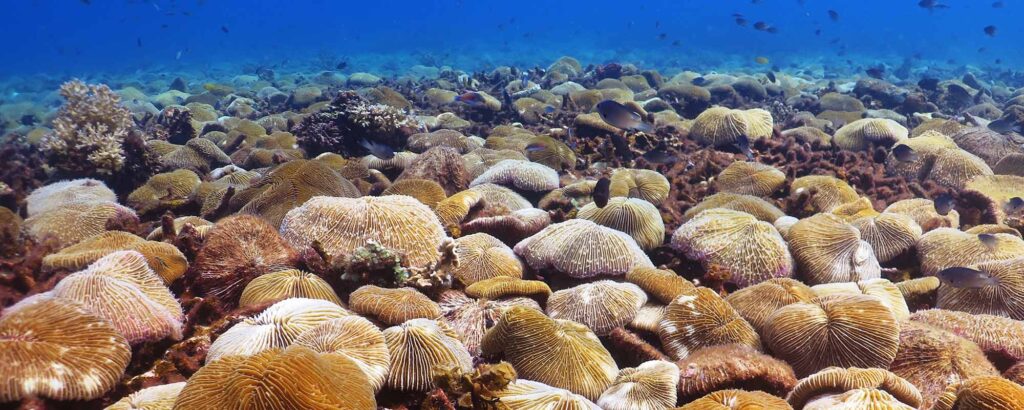
Corals are adapted to particular environmental ranges. When sea temperatures remain unusually high for long enough, the relationship between coral and algae can break down.
Scientists therefore look at both the temperature anomaly and how long the heat stress lasts. NOAA Coral Reef Watch uses satellite observations to monitor accumulated heat stress and the risk of bleaching around the world.
In June 2026, NOAA reported that the fourth global coral bleaching event likely concluded in mid-2025 after bleaching-level heat stress affected about 84% of the world’s coral reef area between early 2023 and mid-2025.
You can follow current global heat-stress monitoring through NOAA Coral Reef Watch.
What Does Global Bleaching Mean for Koh Tao?
Global bleaching events do not affect every reef in exactly the same way. Local water temperatures, currents, depth, coral species and previous exposure to stress can all influence the outcome at an individual site.
Koh Tao has experienced bleaching events in the past, including a significant event in 2010 that became the subject of scientific research involving local conservation teams and academic collaborators.
That history demonstrates why long-term monitoring matters. A single photograph can show that a coral is pale on one day, but repeated observations help researchers understand survival, recovery and changes in reef composition.
Climate Change and Local Reef Stress Are Connected
Climate-driven marine heatwaves are the main cause of widespread thermal bleaching, but coral resilience can also be influenced by local conditions.
Pollution, sedimentation, physical damage, disease and other pressures can make recovery harder. NOAA notes that reefs repeatedly exposed to multiple stresses may have less capacity to recover from disturbances.
This means local conservation still matters even though individual visitors cannot solve global ocean warming on their own.
How Visitors Can Reduce Local Pressure on Reefs
The most useful actions are simple and conservation-focused: do not touch coral, do not collect marine life or reef material, follow local environmental rules and respect instructions intended to protect sensitive habitats.
Visitors can also support organisations that take marine conservation seriously, reduce unnecessary single-use waste and communicate honestly about reef conditions.
Why You Should Never Touch Bleached Coral
Bleached coral can still be alive. Its white appearance does not make it an inert rock or a suitable surface to touch, stand on or move.
Physical contact can add another source of stress to a colony that may already be struggling with elevated temperature.
The same principle applies to healthy-looking coral: observe from an appropriate distance and leave the reef as you found it.
Can Coral Reefs Recover After Bleaching?
Yes, recovery is possible when stressful conditions ease quickly enough.
NOAA explains that corals can recover from mild bleaching by repopulating their tissues with algae. Recovery becomes less likely when bleaching is severe, repeated or prolonged.
Reef recovery is also broader than the fate of a single colony. Scientists study coral recruitment, species composition, disease, structural complexity and the return of ecological functions over much longer periods.
The Role of Coral Monitoring
Monitoring allows researchers and conservation teams to compare reef condition over time and distinguish short-term visual changes from longer-term ecological trends.
Depending on the project, monitoring may record coral cover, bleaching prevalence, disease, recruitment, species composition or other indicators.
Consistent methods are important because useful conservation data must be comparable across sites and dates.
Marine Conservation at Big Blue
Big Blue has a long history of marine conservation education and research involvement on Koh Tao.
Our marine conservation section includes information on coral and fish identification, shark and turtle ecology and research-focused programmes.
The Coral Identification page introduces coral ecology, identification and threats including bleaching.
Bleaching Is a Warning, Not a Reason to Give Up
The scale of recent global bleaching is serious. NOAA’s assessment of the fourth global event shows how widespread modern heat stress has become.
But it is also important to communicate coral science accurately. Bleaching is a stress response, not an automatic declaration that every affected colony is dead. Some corals recover, some do not, and long-term outcomes vary between sites and species.
For people who care about reefs, the useful response is to support good science, reduce avoidable local pressures and treat coral ecosystems with care.
Learn More About Koh Tao’s Coral Reefs
Explore Big Blue’s Koh Tao marine-life guide for more information about the reef community and the species that depend on it.
