


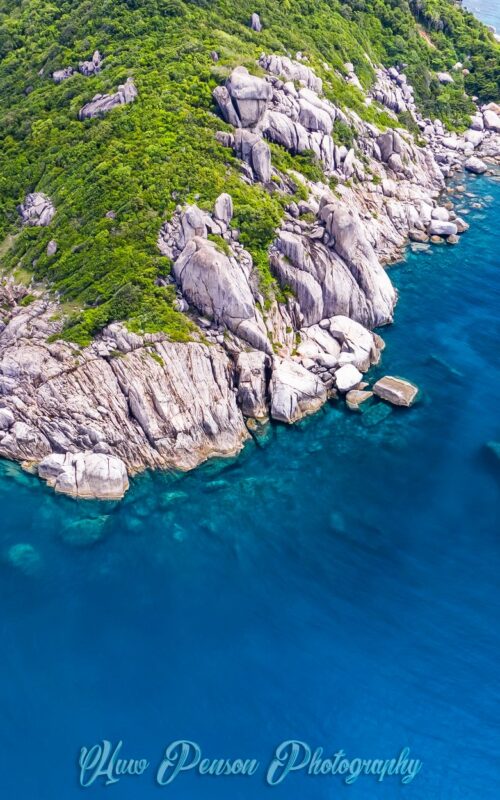
If you’ve ever gone scuba diving in Thailand, chances are you’ve heard about the famous Koh Tao dive sites — that small island that punches well above its weight in coral, sea turtles, and dive certifications. Koh Tao, which literally means “Turtle Island,” is often called the scuba diving capital of Thailand, and for good reason. With calm seas, vibrant reefs, and more dive sites than coffee shops (which is saying something), it’s a paradise for both beginners, seasoned divers , & Tech divers.
Among these underwater treasures, three sites stand out for their curious, color-coded names — Red Rock, White Rock, and Green Rock. The story of how these came to be isn’t just about geology or marine life. It’s about a man, a flag, and a touch of Italian flair that helped shape Koh Tao’s early diving history.
A Pioneer with a Sense of Style
According to local dive lore, the story begins with Cesare Benelli, one of the first scuba diving pioneers on Koh Tao. Back in the early days — long before the island became a global diving hotspot — Cesare was among a small group of adventurous souls who saw beyond the jungle and granite. They saw reefs, pinnacles, and the kind of underwater beauty that could make even the most jaded traveller drop everything and start logging dives.
Cesare was Italian, and like any proud Italian, he carried a little piece of home with him — even underwater. So, when he explored and began naming new dive sites around Koh Nang Yuan, he couldn’t resist a small patriotic flourish. Red, white, and green — the colors of the Italian flag — were soon immortalised beneath the waves.
Whether by design or coincidence, the trio became legendary. To this day, Red Rock, White Rock, and Green Rock remain among the most famous dive sites in Koh Tao, each with its own story, mood, and personality.
🟥 Red Rock – The Fiery Pinnacle of Koh Nang Yuan
Just off Koh Nang Yuan, Red Rock — also known as Nang Yuan Pinnacle — rises to within a single meter of the surface. For anyone piloting a dive boat, that’s just enough to keep your heart rate interesting. But for divers, it’s a dream: a site where sunlight paints the granite in hues of copper and crimson, especially in the late afternoon.
The color comes from the rock’s natural mineral content and a thin coating of reddish marine algae. In the right light, it almost seems to glow — a small underwater volcano that never erupted. Whether Cesare named it for its real tint or simply needed a “red” for his underwater tricolore, the result is the same: a dive site that’s both beautiful and symbolic.
Along the coast of Nang Yuan is also known for its vibrant coral gardens, colorful nudibranchs, and the occasional hawksbill turtle drifting past and an exciting cave/ swimthru know as Nang Yuan Cave. Many divers start here and finish their dive by drifting into Japanese Gardens, one of Koh Tao’s most scenic shallow sites.
⚪ White Rock – The Pale Giant Beneath the Waves
If Red Rock is fiery and dramatic, White Rock is its calmer, paler cousin — a massive submerged boulder that rises to about two meters below the surface. From above, the site appears as a light patch in the deep blue, easy to spot even from a boat.
The “white” in White Rock is the subject of much debate. Some say it comes from sun-bleached coral skeletons and fine, pale sand coating the granite. Others swear it’s thanks to light reflection off the shallow seabed — and, of course, there are those who prefer the less glamorous but persistent theory involving seabird guano. Whatever the truth, the name fits perfectly as the cool, neutral centerpiece of Koh Tao’s tricolore.
Today, White Rock is one of the most famous dive sites in Koh Tao, popular for both day dives and night dives. It’s a place of constant motion — schools of fusiliers, parrotfish, stingrays, and sleeping turtles tucked under coral bommies. When the sun sets, the site transforms into a bioluminescent wonderland where divers can see feather stars unfurl, crustaceans scuttle, and reef predators begin their nightly patrols.
🟩 Green Rock – The Emerald Labyrinth
Venture just north of Koh Nang Yuan and you’ll find Green Rock, a site that has tested both navigation skills and nerves for decades. It’s famous for its network of tunnels, caverns, and swim-throughs, many of which twist and turn in ways that make divers feel like explorers charting new territory.
As for its name, there are two theories — one practical, one poetic. The first is that the site gets its name from the greenish hue created by sunlight filtering through the turquoise water, reflecting off nearby coral gardens. The second, and perhaps more romantic version, is that Cesare named it in memory of the rolling green hills of Italy, a nostalgic nod to home while he explored his new underwater frontier.
Either way, Green Rock remains one of the most exciting and adventurous dive sites in Koh Tao, offering encounters with groupers, trevallies, and the occasional triggerfish on patrol. It’s a dive site that rewards the curious — and humbles the overconfident.
🌊 A Legacy That Lives Beneath the Waves
Whether it was pure patriotism or a happy coincidence, Cesare Benelli’s legacy lives on every time a diver rolls off a boat at Red Rock, White Rock, or Green Rock. Together, they form a colorful chapter in the story of scuba diving in Koh Tao, representing both the island’s rich diving history and the sense of discovery that continues to draw divers from all over the world.
So next time you’re exploring one of these famous Koh Tao Dive Sites, take a moment to picture Cesare — an Italian far from home, looking out across a sapphire sea and deciding that if Italy could have its tricolore flying proudly on land, Koh Tao could have one waving gently beneath the waves.
