


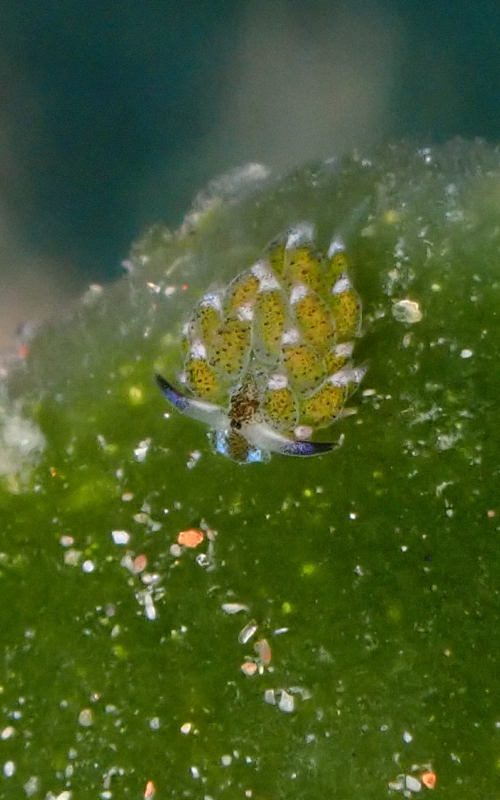
Whale sharks and turtles may receive most of the attention, but some of Koh Tao’s most remarkable marine animals are only a few centimetres long.
Nudibranchs are colourful marine gastropods commonly known as sea slugs. They occur in an extraordinary range of shapes, patterns and colours, and finding one can turn an ordinary wildlife observation into a miniature natural-history encounter.
For anyone interested in nudibranchs in Koh Tao, this guide explains what they are, why they are so colourful, what they eat and how to distinguish them from some of the other small animals found around coral reefs.
What Is a Nudibranch?
Nudibranchs are soft-bodied marine gastropod molluscs. They are related to snails, but adults lack the obvious external shell associated with most familiar land and marine snails.
The name “nudibranch” comes from words meaning “naked gill”, referring to the exposed respiratory structures visible on many species.
There are thousands of described nudibranch species worldwide, ranging from tiny animals that are easily overlooked to much larger species such as Spanish dancers.
Why Are Nudibranchs So Colourful?
Nudibranch colouration can serve several purposes.
Some species use bright warning colours that advertise chemical or physical defences. Others blend surprisingly well with the sponges, hydroids, coral or other surfaces on which they feed.
The result is a group of animals that can look almost unreal: electric blues, oranges, yellows, reds, purples and intricate combinations of spots, stripes and contrasting edges.
Colour alone is not always enough for reliable identification because appearance can vary between individuals and closely related species can look similar.
What Are Rhinophores?
One of the easiest features to notice on many nudibranchs is a pair of structures on the head called rhinophores.
These sensory organs help the animal detect chemical information in the surrounding water. Depending on the species, they may look smooth, ribbed, feathered or club-shaped.
At the opposite end of the body, many dorid nudibranchs have a visible circle or cluster of feathery gills. Other groups have rows of finger-like structures called cerata along the back.
What Do Nudibranchs Eat?
Nudibranch diets are surprisingly specialised.
Different species may feed on sponges, hydroids, bryozoans, anemones, soft corals, eggs or even other sea slugs. This close relationship with their food source is one reason experienced naturalists pay attention to the substrate as well as the animal itself.
How Do Nudibranchs Defend Themselves?
Without a heavy external shell, nudibranchs rely on other defences.
Some produce or store chemicals that make them unpleasant to predators. Others can incorporate defensive compounds obtained from their food.
Certain aeolid nudibranchs are famous for an even more unusual strategy: they can consume stinging organisms such as hydroids and retain functional stinging cells in specialised structures within their own bodies.
Are All Sea Slugs Nudibranchs?
No. “Sea slug” is a broad informal term that includes several groups of shell-less or reduced-shell marine gastropods.
Nudibranchs are one particularly diverse group, but there are other sea slugs that belong to different evolutionary lineages.
Flatworms can cause additional confusion because some species have similarly bright colours and undulating body shapes, even though they are not molluscs at all.
Nudibranchs Around Koh Tao
Big Blue’s Koh Tao nudibranch guide notes that these animals can be found on coral reefs, rocky substrates and sandy patches around the island.
Because many are small, they reward patience and close observation. A section of reef that appears empty from a distance may contain several species once you start noticing sponges, hydroids and other small-scale habitats.
Why Macro Marine Life Is Worth Your Attention
Large animals are exciting, but focusing only on them can mean missing most of what is happening on a reef.
Small creatures occupy specialised ecological roles as predators, grazers, cleaners, filter feeders and prey. Once you begin noticing macro life, the reef can feel dramatically more complex.
An older Big Blue article on macro marine life in Koh Tao highlights tiny shrimp, crabs, gobies, seahorses and colourful sea slugs that are easy to overlook.
Can Nudibranch Colours Tell You the Species?
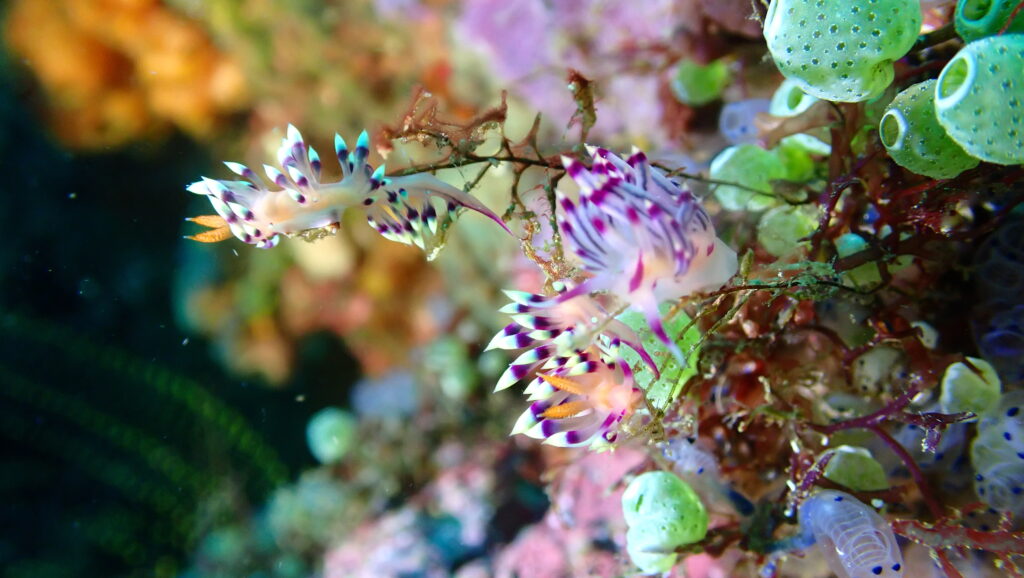
Sometimes colour and pattern provide useful clues, but identification should use more than one characteristic.
Useful details can include:
- Overall body shape
- Rhinophore shape and colour
- Gill arrangement
- Presence or absence of cerata
- Body-edge pattern
- Approximate size
- The habitat or food organism on which the animal was found
Photographs should be treated as identification evidence rather than an invitation to move the animal into a more convenient position. Marine life should be left where it is found.
Nudibranch Reproduction
Most nudibranchs are simultaneous hermaphrodites, meaning each individual has both male and female reproductive organs.
After mating, many species lay distinctive ribbons or coils of eggs on the reef. These egg masses can be surprisingly beautiful in their own right.
Spanish Dancers: The Famous Large Nudibranch
Among the best-known nudibranchs are Spanish dancers, large red or orange animals named for the dramatic swimming motion they can display.
When disturbed, the body can undulate through the water in a way that resembles the movement of a dancer’s skirt.
Despite that spectacular behaviour, wildlife should never be deliberately disturbed simply to produce a photograph or video. A natural encounter is always the better encounter.
Responsible Marine-Life Photography
Nudibranchs are popular photography subjects because they move slowly and display intricate colour patterns.
The welfare of the animal and surrounding reef should come before the image. Avoid touching, repositioning or crowding a subject, and never damage coral or other organisms to create a clearer background.
Why Nudibranchs Matter
Nudibranchs are more than colourful subjects for photographs. They are specialised predators, prey for other animals and part of the complex network of relationships that makes coral reefs so biologically diverse.
They are also a useful reminder that marine biodiversity exists at every scale. Some of the most interesting wildlife observations on Koh Tao are not the animals visible from across the reef, but the tiny species hiding in plain sight.
Explore More Koh Tao Marine Life
Explore Big Blue’s Koh Tao marine-life guide for more information about the fish, turtles, rays, eels and other species found around the island.
Observe carefully, photograph responsibly and let the reef keep its secrets for the next visitor to discover.
