


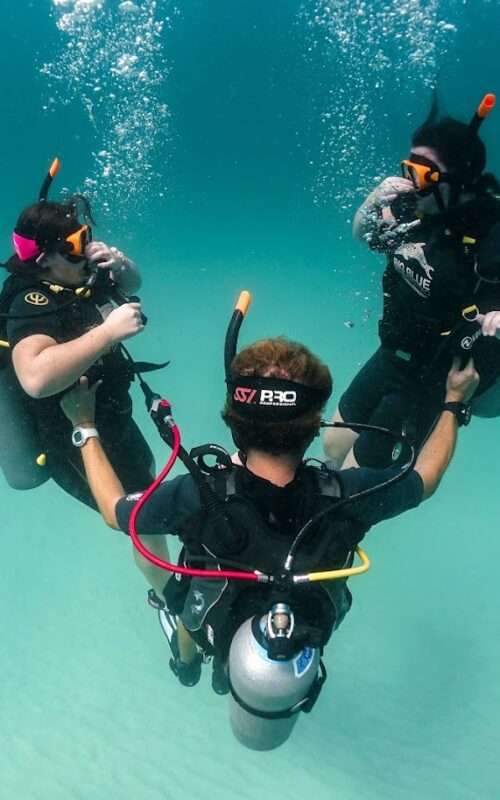
Taking your first breath underwater can feel strange for a few seconds. Your instincts know that people are not supposed to breathe beneath the surface, but the regulator delivers air, your breathing settles and an entirely new environment opens in front of you.
If you want to try scuba diving in Koh Tao but are not ready to commit to a full certification course, a one-day introductory experience is an ideal place to start.
You do not need previous scuba experience, your own equipment or an existing diving certification. You begin with a safety briefing and pool training before joining an instructor for two supervised dives at shallow sites around Koh Tao.
This guide explains how a first-time scuba experience works, what you will practise, what the ocean dives feel like and how you can continue into a certification course if you enjoy it.
Can You Try Scuba Diving Without a Certification?
Yes. You do not need to be a certified diver to experience scuba diving for the first time.
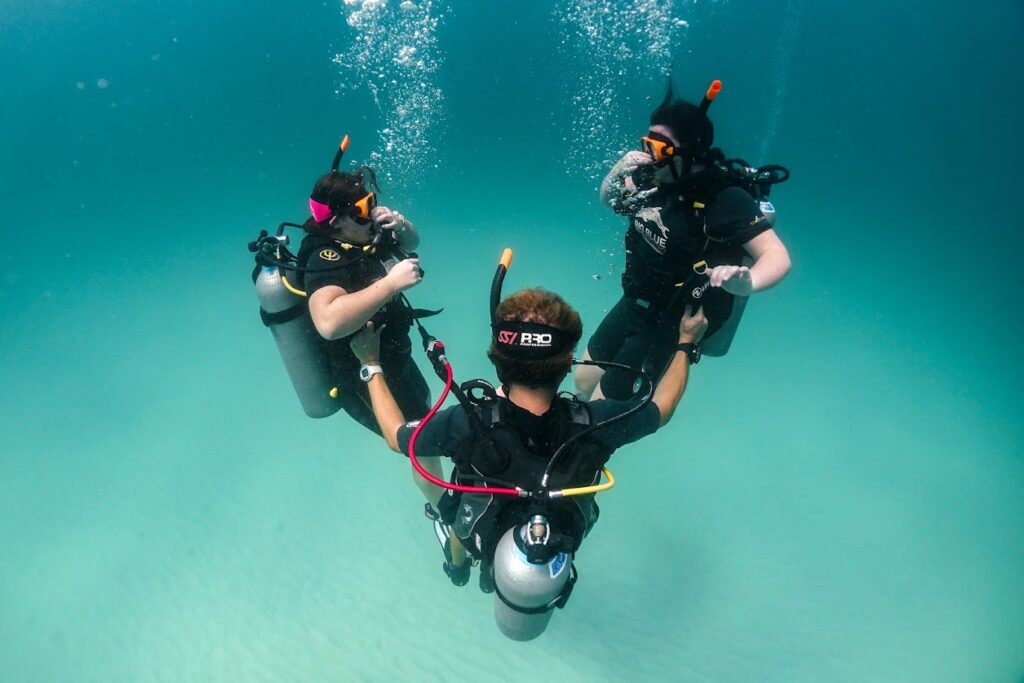 Big Blue’s Basic Scuba Diver experience is designed specifically for complete beginners. It provides the instruction, equipment and close professional supervision needed to experience scuba diving without immediately enrolling in a multi-day certification course.
The programme includes:
- An introduction to scuba equipment and basic safety procedures
- Practical training in a swimming pool
- Two supervised dives in the sea
- Use of the required scuba equipment
- Boat trips to shallow dive sites around Koh Tao
- A maximum depth of 12 metres
It is an introductory experience rather than a full diving certification. You will remain under the direct supervision of your instructor throughout the ocean dives.
Who Is a Try-Dive Experience For?
A one-day introduction can be suitable if you are curious about diving but do not yet know whether you will enjoy breathing underwater.
It is particularly useful for people who:
- Have never used scuba equipment before
- Feel nervous about committing to the full Open Water course
- Only have one available day in Koh Tao
- Want to experience diving as part of a holiday
- Would prefer to build confidence gradually
- Want to decide whether certification is right for them
There is no need to rush into a full course simply because other travellers are getting certified. Trying diving for one day lets you make the decision based on your own experience.
Do You Need to Be a Strong Swimmer?
There is no formal swimming test for the Basic Scuba Diver experience.
You will be wearing buoyancy equipment and remain under close instructor supervision. However, you should tell the dive school before booking if you cannot swim, feel anxious in deep water or have previously had a difficult experience in the ocean.
Being honest about your water confidence allows your instructor to provide appropriate support and determine whether the experience is suitable for you.
The full SSI Open Water Diver course has separate swimming requirements, including a distance swim and a float or tread-water assessment.
What Happens Before You Enter the Water?
Your day begins by meeting your instructor, completing the required paperwork and discussing how the experience will run.
 You will be introduced to the main pieces of scuba equipment, including:
- The mask and fins
- The buoyancy control device
- The regulator used for breathing
- The alternate air source
- The scuba cylinder
- The pressure gauge
- The weights used to help you descend
Your instructor will explain how the equipment works, how divers communicate underwater and the basic procedures needed to descend, breathe and return safely to the surface.
You are not expected to remember everything immediately. The briefing introduces the important ideas before you practise them in the pool.
Your First Time Breathing Underwater
The practical session begins in the swimming pool, usually in water shallow enough for you to stand comfortably.
You will place your face in the water and begin breathing through the regulator. The first few breaths can feel unfamiliar, but most people become more comfortable once they slow their breathing and realise that the equipment is supplying air normally.
There is no prize for adapting immediately. Some people relax within seconds, while others need more time. Your instructor can pause, demonstrate a skill again or let you repeat it until you feel ready to continue.
What Skills Will You Learn in the Pool?
The pool session introduces the basic skills needed before diving in the sea.

These normally include:
- Breathing through a scuba regulator
- Clearing water from your mask
- Recovering the regulator if it leaves your mouth
- Equalising the pressure in your ears
- Using simple underwater hand signals
- Inflating and deflating your buoyancy control device
- Moving through the water using fins
- Responding calmly to your instructor
The controlled environment allows you to practise without waves, currents or the distractions of an open-water dive site.
Once you and your instructor are satisfied that you are comfortable using the equipment, you can progress to the ocean portion of the experience.
What if You Feel Nervous in the Pool?
Feeling nervous does not mean you are incapable of diving. Breathing underwater is an unusual experience, and it can take time for your mind and body to adjust.
Tell your instructor immediately if you feel uncomfortable. They may:
- Return with you to shallower water
- Repeat the breathing exercise
- Break a skill into smaller steps
- Give you more time to practise
- Adjust the equipment
- Stop the session if continuing is not appropriate
You should never feel pressured to enter deeper water before you are ready. The purpose of the pool session is to establish comfort and basic control before going to sea.
What Happens During the First Ocean Dive?
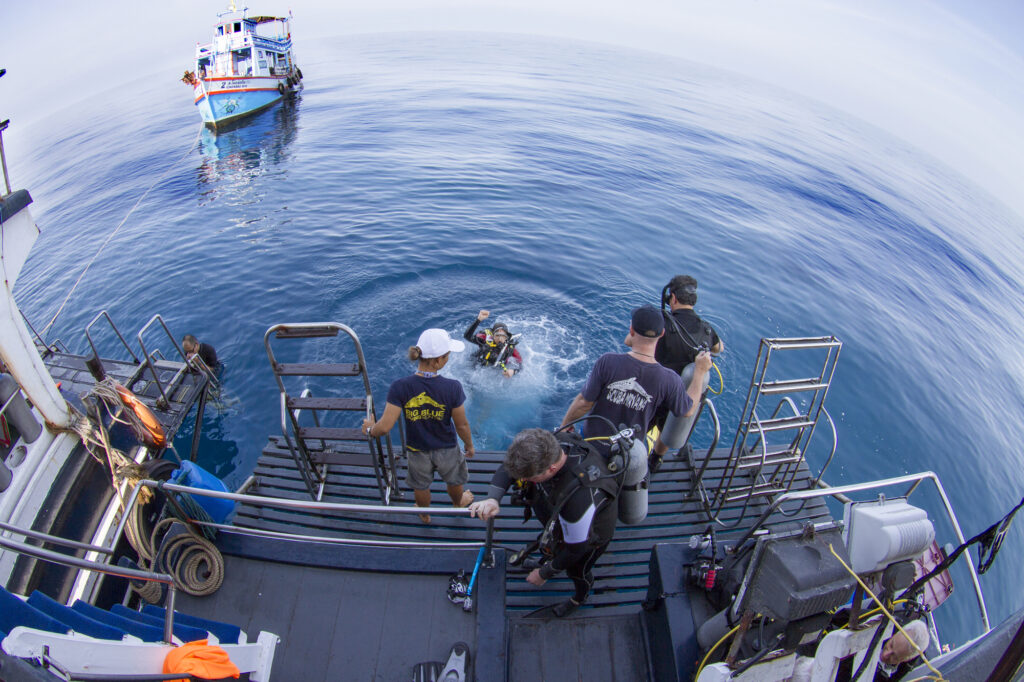
After the pool session and a break for lunch, you will join an afternoon boat trip to shallow dive sites around Koh Tao.
Your instructor will give you another briefing before entering the water. This will cover:
- The dive site and planned route
- How you will enter and leave the water
- The maximum planned depth
- How to descend and equalise your ears
- The hand signals you will use
- How to communicate if you are uncomfortable
- What to do if you need to return to the surface
The descent is controlled and gradual. Your instructor will remain close, watch your breathing and regularly check that you are comfortable.
Your first sea dive normally takes place at a shallow, beginner-friendly site. Instead of looking at the bottom of a swimming pool, you may find yourself moving above coral, sand and tropical reef fish.
What Does Your First Dive Feel Like?

The first few minutes often require the most concentration. You may be thinking about your breathing, equalising your ears, your body position and where your instructor is.
As you become more comfortable, the experience usually starts to feel less like a training exercise and more like exploring.
Moving underwater can feel almost weightless. Small movements have a greater effect than many beginners expect, so your instructor will help you slow down, use your fins efficiently and avoid touching the seabed or reef.
Your mask limits part of your peripheral vision, and underwater sounds can be difficult to locate. Staying close to your instructor and regularly checking your surroundings will help you remain oriented.
How Deep Will You Go?
The maximum depth for the Basic Scuba Diver experience is 12 metres, but this is a limit rather than a target.
Your actual depth will depend on:
- Your comfort and skill level
- The selected dive site
- Water and weather conditions
- Your ability to equalise your ears
- Your instructor’s assessment
There is no reason to descend deeper simply to reach the maximum. A shallow reef can provide an excellent first dive, with plenty of light, colour and marine life.
What Marine Life Might You See?
The dive sites around Koh Tao are home to a wide range of tropical reef species.
 Depending on the site and conditions, you may encounter butterflyfish, angelfish, anemonefish, parrotfish, groupers, moray eels, stingrays and schools of smaller reef fish.
Larger animals and turtles are sometimes encountered, but no particular wildlife sighting can be guaranteed.
You can explore some of the species found around the island in our Koh Tao marine-life guide.
What Happens Between the Two Dives?
After the first dive, you will have a surface interval on the boat.
This gives you time to:
- Rest and hydrate
- Talk to your instructor about the dive
- Ask questions about anything that felt difficult
- Discuss the marine life you saw
- Decide whether you feel comfortable completing the second dive
Completing the first dive does not obligate you to make the second. Tell your instructor how you feel and make the decision based on your comfort.
What Is the Second Dive Like?
Many beginners find the second dive more relaxing because the equipment, breathing and descent process are no longer completely new.
The second dive is primarily an opportunity to explore. You can concentrate more on the reef, marine life and the sensation of moving underwater while your instructor remains nearby.
You may also begin to notice improvements in your breathing and body position. These early changes are part of the reason many people return from their first day wanting to continue their training.
Is Trying Scuba Diving Safe?
Introductory scuba programmes are structured to reduce risk through training, conservative depth limits, suitable dive-site selection and close professional supervision.
You still need to follow the instructor’s directions and communicate whenever something feels wrong.
Important safety principles include:
- Never hold your breath while using scuba equipment
- Equalise your ears early and regularly during descent
- Do not continue descending if your ears hurt
- Stay close to your instructor
- Check your pressure gauge when instructed
- Move slowly and avoid rushing to the surface
- Do not touch coral or marine animals
- Tell your instructor immediately if you feel unwell or uncomfortable
You can read more about the structure of an introductory programme on the official SSI Basic Diver page.
Medical Requirements for Trying Scuba Diving
Scuba diving requires a suitable level of physical health. Before participating, you will need to complete a medical questionnaire.
A “yes” answer does not automatically prevent you from diving, but you may need written medical clearance before entering the water.
Contact the dive school before booking if you:
- Have a heart, lung or circulation condition
- Have a history of seizures or loss of consciousness
- Have recently undergone surgery
- Take regular prescription medication
- Are pregnant or may be pregnant
- Have another health concern that could affect diving
Do not wait until the morning of the experience to raise a known medical concern, as obtaining the required clearance may take time.
How Old Do You Need to Be?
The minimum age for Big Blue’s Basic Scuba Diver experience is 10 years.
Age alone does not determine whether a child is ready. Comfort in the water, maturity, attention and the ability to understand and follow safety instructions should also be considered.
Parents looking for structured training for younger divers can view Big Blue’s scuba diving courses for children.
What Should You Bring?
Big Blue provides the scuba equipment and boat transport required for the programme.
You should bring:
- Swimwear
- A towel
- Reef-safe sun protection
- A reusable water bottle
- Any required medical clearance
- Dry clothing for after the boat trip
Avoid arriving dehydrated, exhausted or unwell. Eat a sensible meal before diving and avoid excessive sun exposure before the afternoon boat trip.
Can Your Try Dive Count Towards Open Water Certification?
Yes. If you decide to continue into the SSI Open Water Diver course within six months, your first qualifying open-water dive from the Basic Scuba Diver experience can be credited towards the course.
Your instructor will explain which training has been completed and what requirements remain.
This makes the introductory experience a practical option if you want to try diving before deciding whether to commit to certification.
What Are Your Options After the First Dive?
You do not need to decide your entire diving future immediately. After completing the experience, you have several options.
Finish After the One-Day Experience
You can treat the day as a standalone holiday activity. There is no obligation to continue into further training.
Complete the SSI Scuba Diver Course
The SSI Scuba Diver course is a shorter entry-level certification for people who have limited time.
It allows you to dive to a maximum depth of 12 metres while under the direct supervision of a qualified diving professional.
Continue Into the SSI Open Water Diver Course
The SSI Open Water Diver course in Koh Tao is the complete beginner certification.
It includes academic learning, pool training and four required open-water dives. Eligible adult students can become certified to dive to a maximum depth of 18 metres with another appropriately certified diver.
You can compare all three pathways on our beginner scuba diving courses page.
Do You Need to Wait Before Flying?
You must leave a suitable interval between scuba diving and flying or travelling to significant altitude.
Big Blue currently advises participants not to fly within 24 hours of their final dive. Consider this when planning ferries, onward transport and flights.
Further safety information is available from the Divers Alert Network guidance for flying after diving.
Why Try Scuba Diving in Koh Tao?
Koh Tao has numerous shallow reefs and bays that can provide suitable environments for introductory diving when conditions allow.
The island also has an established diving community, dedicated training facilities and a wide choice of beginner, advanced and professional courses.
At Big Blue, your pool training takes place before the ocean dives, allowing you to practise using the equipment in a controlled environment before boarding the afternoon dive boat.
You can learn more about the facilities, instructors and boats on our Koh Tao dive school page.
Should You Try Snorkelling First?
Snorkelling is not required before trying scuba diving, but it can be useful if you are unsure how comfortable you feel in the sea.
Spending time swimming with a mask and snorkel can help you become familiar with breathing while your face is in the water. However, snorkelling feels different from scuba diving because you remain at the surface rather than breathing from an independent air supply underwater.
If you are interested in scuba diving, the pool session provides a more accurate introduction while still allowing you to begin in shallow, controlled water.
Frequently Asked Questions About Trying Scuba Diving
Do I need previous scuba experience?
No. The Basic Scuba Diver experience is designed for complete beginners.
Will I receive a diving certification?
No. It is an introductory experience rather than a full diver certification. You can continue into SSI Scuba Diver or Open Water training afterwards.
How many sea dives are included?
The current Big Blue programme includes pool training followed by two supervised sea dives.
What is the maximum depth?
The maximum depth is 12 metres, although your actual depth may be shallower depending on your comfort, conditions and your instructor’s assessment.
Do I have to complete both dives?
No. You can discuss how you feel with your instructor after the first dive before deciding whether to continue.
Will I see fish and coral?
The dives take place at natural dive sites, so you are likely to encounter reef life. However, particular animals and conditions cannot be guaranteed.
Can I start the Open Water course afterwards?
Yes. You may be able to continue directly into Open Water training, subject to availability and meeting the course requirements.
Take Your First Breath Underwater
Your first scuba dive may feel exciting, unfamiliar and slightly awkward at the same time. You are learning to breathe, communicate and move in an environment that is completely different from life on land.
You do not need to look graceful or feel confident immediately. The purpose of a try dive is to experience scuba diving safely, discover how you respond underwater and decide whether you would like to continue.
View the current schedule, requirements, inclusions and booking information for the Basic Scuba Diver experience in Koh Tao.
