


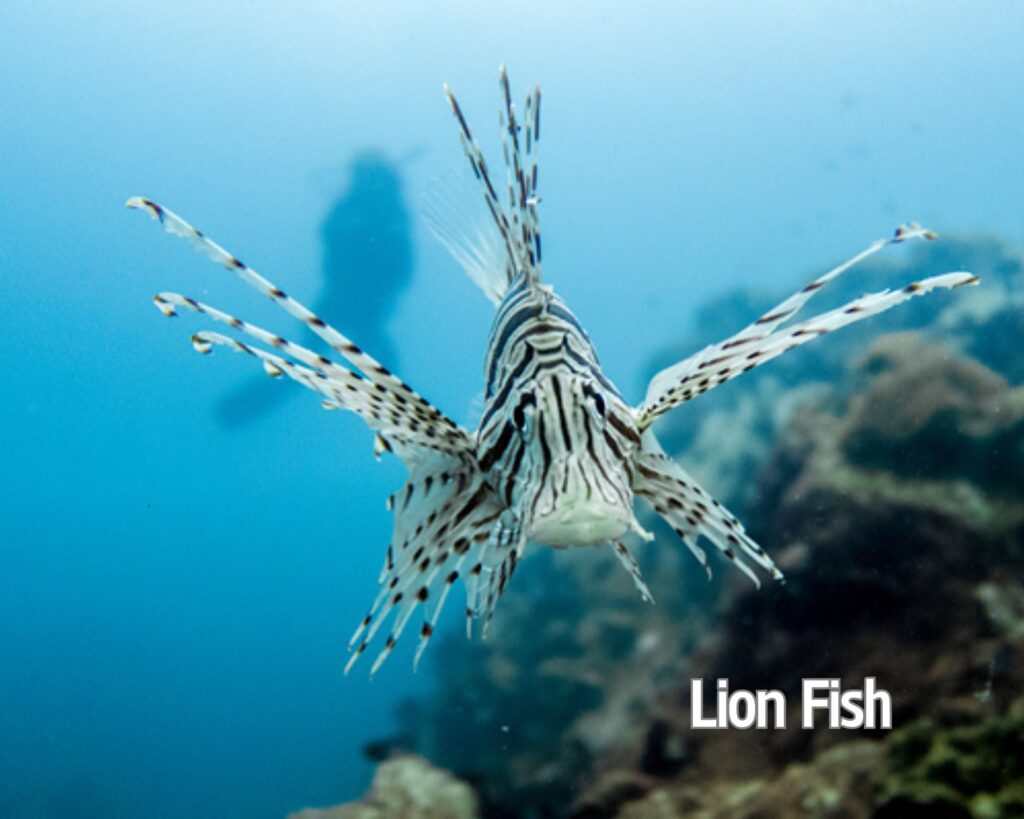
Lionfish
Scientific name Pterois miles
The common lionfish is a species of ray-finned fish found in the Indo-Pacific region. The scientific name comes from the Greek word ‘pteron’, meaning “wing”, and the Latin word ‘miles’, meaning “soldier”. Common lionfish can grow to be fairly large, up to 14 inches in length. Their dorsal fins have 13 strong spines, with three more spines on their anal fins. Each spine has a soft ray that gives the fish the look that it is covered in silk sails.
But make no mistake – these spines may look pretty but you don’t want to touch them. They are highly venomous spines and have caused death to humans. Although there is no reason to fear them. They are not aggressive to divers who respect them. When upset they will raise their fins as a warning and will try to move away. But if they’re cornered they can charge a threat with incredible speed.
They can be found either singly or in family groups spending the daytime hiding in crevices and under rock formations. At night they go out hunting for food.
While lionfish are common here in Thailand, a hapless aquarium enthusiast in the America’s released one into the ocean on that side of the world and it has since caused an infestation of lionfish that have no natural predators in that ecosystem. They have become an invasive species in the Caribbean and to try and keep the numbers down locals will hold almost daily hunts and fishing competitions, and national supermarket chains have started to sell lionfish filets.
Find Lionfish at...
Divemaster's tip
Are you heading out to Twins for a dive? Most people who are already certified divers would skip the shallow pinnacle at Twins in favourite of the middle and deep pinnacles. But think twice if it’s lionfish you seek! Head to the east side of the shallow pinnacle, close to Nang Yuan Island, and keep your eyes out for teeny, tiny lionfish. This area is a known nursery for young lionfish.
What do they eat?
Lionfish typically eat molluscs, small fish and invertebrates. Interestingly, they don’t use their spines to hunt their food. Rather, once they’ve cornered something, they lung out and swallow their prey whole. Their stomachs can expand up to 30 times their original size and lionfish can swallow prey up to half their entire body length.
