


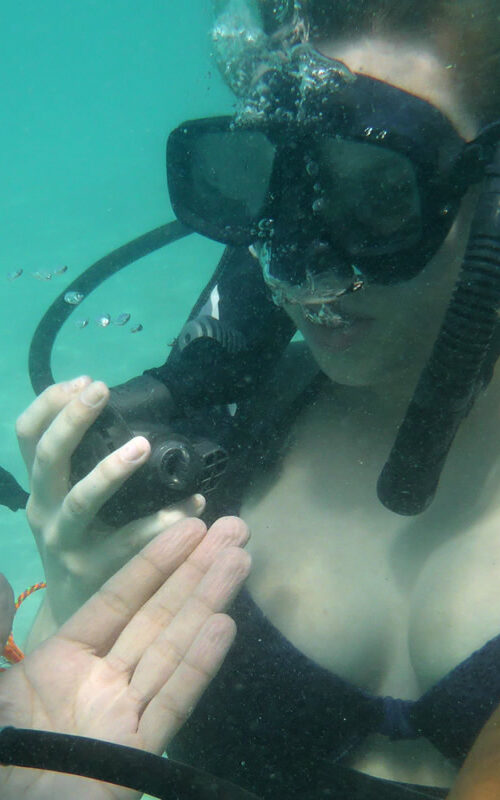
To become a dive instructor you need to enroll in the Instructor Training Course which takes 10 days and is followed by the IE (Instructor Examination), so 12 full days wherein you will learn everything that prepares you to become a dive instructor:
Here’s what those 12 days consists of.
Dive theory and classroom presentations: not only do you need to have a fundamental knowledge of dive theory, you are also expected to present this theory in clear and structured lectures. Expect a lot of test exams and classroom presentations on topics like dive physics, physiology, equipment and decompression theory. The theory is the same as what you learned during your Dive Control Specialist or Divemaster course.But now you need to explain or teach this to your students!
SSI training standards: As an SSI instructor you can’t just do what you want. There are standards that define the maximum depth, the group size and how many training dives you can do on a day. Minimum equipment requirements, paperwork that needs to be done and what skills need to be covered on a certain course. These standards guarantee that the students receive safe and consistent training, anywhere in the world.
Confined Water practice: By now you probably know how to remove your mask, adjust your buoyancy or how to share air with a diver that is out of air. But as an instructor you need to be able to explain and demonstrate these skills in a clear way, keep the group under control and evaluate your students to decide if they are comfortable or need more practice. So we spend a lot of time in our swimming pool at Big Blue to practice this to perfection.
Open Water practice: When you take students out to the open water, group control and judgement are even more important than in the swimming pool. You need to have control at all times and be alert of stress and potential dangerous situations. Only then can you avoid problems and make sure that your students are always safe and comfortable during your course. We practice open water dives and skills at our local Koh Tao divesites as part of the Dive Instructor Training course.
Paperwork and administration: It’s not only diving when you work as a dive instructor. Your paperwork needs to be complete and you need to know the proper procedures to certify your students. Luckily this doesn’t take up too much time, but it is very, very important.
The business of diving: Diving has become a big industry and it is very interesting to see how dive schools do their business. Competition is big and it is interesting to see the costs and procedures that run behind the scenes. What are the costs in a dive school or during a course? Is it good to be low budget or better to be top end? We will discuss this in the form of workshops.
Diving and the environment: It is becoming very clear that the divesites around the world are under threat by pollution, overfishing and rising temperatures. But what about divers? Are they good or bad for the reefs? And what can we do to keep the impact as minimal as possible or even make a positive difference?
Safety and judgement: Even with all the paperwork, training standards and practice, diving is still a potentially dangerous activity. We can’t prepare you for every imaginable problem, but we can teach you to use your judgement and prevent problems in the first place. Only then will you be able to be a good instructor.
Which is exactly why you want to be doing your Instructor Training with us at Big Blue Pro with Instructor Trainers Simon Garrity & Gus Rae
Find out more by checking out our Instructor Training page or drop us an email and a belated congratulations to our New Open water instructors Tom and Gregoire who completed their SSI Instructor Courses with Big Blue Pro SSI Instructor Trainer Gus Rae.
