


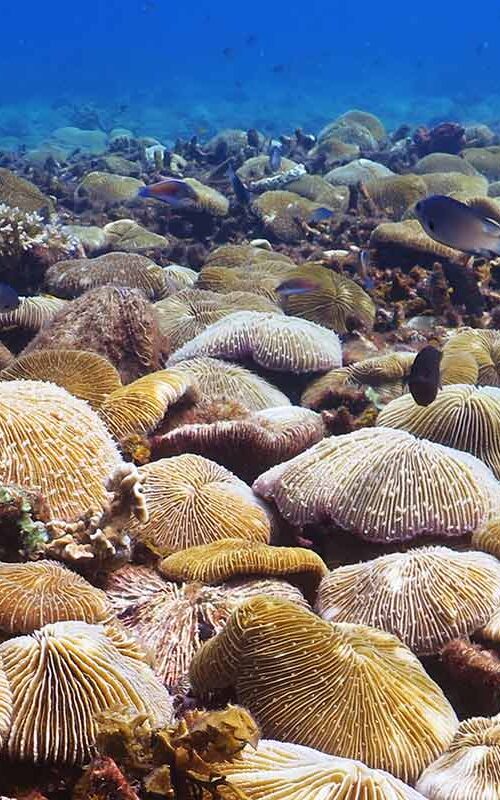
The more Marine biologists come here the better coral conservation on Koh Tao has become. There is now a genuine interest in corals where as before they were very much second rate after the bigger marine species. But isn’t coral a form of Marine species too?
Isn’t coral just a type of underwater stone?
Just like superman was mistaken for a bird, corals have a bad habit of also being mistaken for things they’re not. However, the mistake could be far more damaging to the coral than it was for superman, as coral gets mistaken for stone, on many occasions, primarily due to its stone/rock-like appearance and its lack of mobility.
In fact, there is a group of corals that actually have the alias stony coral, they are part of the Porites genus. They are characterized by a finger-like morphology and bilaterally symmetrical growth which is then able to form large massive and submassive boulder-like structures. Their growth shape also encourages burrowing organisms like Christmas tree worms and clams.
This genus of corals can be found throughout the world in most tropical to subtropical regions. A colony of this genus found on the Great Barrier Reef was believed to be approximately 700 years old, growing at a rate of 1 cm a year.
This genus of coral is typically known for its ability to demonstrate a high level of halotolerance, basically changes in salinity levels. This comes in handy when living in tidal areas when you could have salinity fluctuations of up to 30%. Just like many coral Porites, have a symbiotic relationship with an algae group known as zooxanthellae, which provides them with food, however when water temperatures rise and the algae stop production. The coral will resort back to feeding as a heterotroph, consuming small prey like zooplankton, or brine shrimp.
Porites like many corals are threatened, by climate change, predation, and anthropogenic pollution. When exposed to increased temperatures and pollution the coral’s rate of production dramatically slows. On top of this, the symbiotic algae also reduces in provided additional nutrients under these stressors.
With some of the Porites found across the globe being so old, what can they tell us about their past? What was it like being the oldest living stone back in the day? Well, the skeleton of coral can actually tell us quite a lot. For instance, the salinity levels and oxygen levels at the time during their growth. This can be useful when reconstructing past climates. Helping us to understand the effects of El-Nino’s on corals in today’s climate.
Want to learn more about corals and the wonderful world they live in then, how about signing up for one of our Ecological courses with our in house Marine Biologist.
