


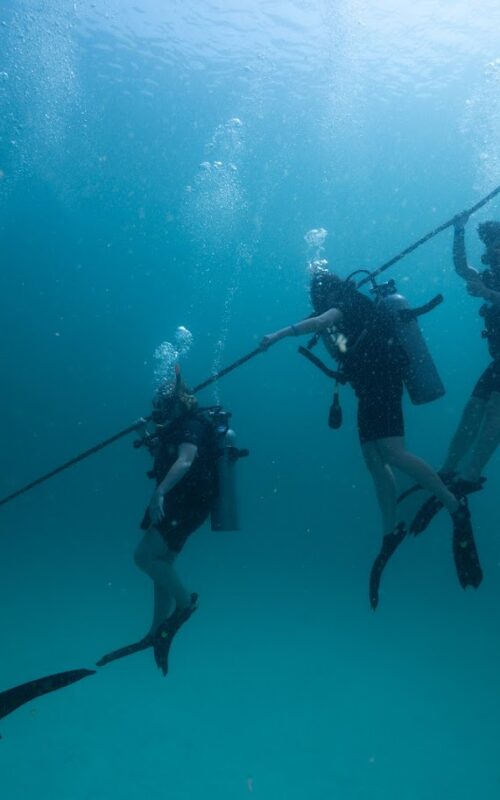
One of life’s great joys — aside from finishing a Thai curry without crying — is floating weightless above a coral reef somewhere in the Gulf of Thailand, surrounded by fish that look like they were designed during a psychedelic art class. But before you can float, you’ve got to sink. Safely, of course — preferably with a certified dive instructor, a buoyancy control device, and the faint knowledge of what to do if a barracuda mistakes your snorkel for lunch. Which is why you’re asking:
“How long does it take to get Open Water certified in Thailand, and where’s the best place to do it?”
Well, I’ve trawled the reefs, shops, and shady backpacker forums to bring you an online surfer’s comparison of Thailand’s most popular scuba diving destinations — what they cost, how long they take, and what kind of underwater magic you can expect.
❝Strap a tank to your back, slap on some fins, and prepare to be amazed… here’s how long it takes to get Open Water certified.❞
🏝️ 1. Koh Tao – The Diver’s Mecca
Course Duration: 2.5 – 3 days
Cost: ฿9,000–฿11,000 (approx. $250–$310 USD)
Best For: Budget travellers, social dive scene, turtles
What You Get: 4 dives, classroom, pool training, and one heck of a sunset view
Koh Tao is the backpacker dive factory of the world — and that’s a compliment. It certifies more Open Water divers than anywhere else on Earth outside Australia. Dive schools here are like 7-Elevens — there’s one every ten meters, each with a beach bar and a deeply tanned German instructor named Herman. It’s cheap, quick, and the visibility often rivals your grandma’s crystal vase collection.
🌊 2. Phuket – Diving with a Side of Luxury
Course Duration: 3 – 4 days
Cost: ฿13,000–฿16,000 (approx. $370–$460 USD)
Best For: Resort divers, couples, comfort seekers
What You Get: Small classes, western-style facilities, and boat dives in the Andaman Sea
Phuket is the champagne brunch of dive destinations. You’ll likely do your course at a private beach resort, eat your post-dive noodles on a teakwood deck, and share your airspace with luxury yacht crews on their day off. Expect the Andaman Sea’s finest — nudibranchs, lion fish, and reefs with more color than a Gay pride festival.
🐠 3. Phi Phi Islands – Instagrammers’ Paradise
Course Duration: 3 days
Cost: ฿12,000–฿15,000 (approx. $340–$430 USD)
Best For: Party divers, scenery seekers, short stays
What You Get: Quick course, good nightlife, views that hurt your heart
If Leonardo DiCaprio made you want to swim in Thailand, Phi Phi is your spiritual home. The diving is dramatic, with sheer limestone walls and strong currents — which also means slightly fewer beginner-friendly conditions. But for the adventurous, it’s three days of “wow” underwater and “wow, I shouldn’t have had that last bucket” above water.
🌴 4. Koh Phangan – Full Moon & Fin Tips
Course Duration: 3–4 days
Cost: ฿11,000–฿13,000 (approx. $310–$370 USD)
Best For: Those who want to balance diving with mild hedonism
What You Get: Quiet reefs, mid-range prices, and the occasional glowstick still stuck in the coral
Despite its party reputation, Koh Phangan actually has some lovely diving, especially around Haad Yuan and Haad Yao. Dive shops here are a little more spaced out than in Koh Tao, and it feels like everyone is on a slightly slower, more relaxed wavelength (possibly still recovering from last month’s Full Moon).
🏖️ 5. Koh Samui – Comfortable but Limited
Course Duration: 3–4 days
Cost: ฿13,000–฿15,000 (approx. $370–$430 USD)
Best For: Families, honeymooners, package tourists
What You Get: Nice facilities, limited local dive sites (most trips go to Sail Rock or Koh Tao)
Samui is your classic tropical island with infinity pools and air-conditioned transfer vans. But its diving scene isn’t quite as vibrant as its cousins — most of the good dive sites are a boat ride away. Still, if you want comfort and a cocktail at sunset, this is the place.
🌄 6. Krabi (Ao Nang & Railay) – Cliffs & Coral
Course Duration: 3 days
Cost: ฿12,000–฿14,000 (approx. $340–$400 USD)
Best For: Beach-lovers, climbers-turned-divers
What You Get: Great views, decent diving, and Thai food that will ruin you for life
Krabi’s dive scene flies a little under the radar, but it’s a solid choice for combining diving with other adventures like rock climbing and kayaking. You may not get the party vibes of Phi Phi or the training-factory vibe of Koh Tao, but you’ll get your cert and possibly fall in love with Thai green curry forever.
🐋 7. Khao Lak – The Gateway to the Similans
Course Duration: 3–4 days
Cost: ฿13,000–฿16,000 (approx. $370–$460 USD)
Best For: Serious divers, liveaboard lovers, whale shark whisperers
What You Get: Good training, excellent instructors, and the chance to continue on to some of Thailand’s best diving
Khao Lak is where people go to get certified before hopping on a liveaboard to the Similan or Surin Islands. The town itself is quiet, the dive shops are efficient, and the instructors are the types who have logged more dives than you’ve had Pad Thais. If you’re serious about going deeper, this is your place and these are your guys: Big Blue Diving Khao Lak.
🧭 So… How Long Does It Take to Get Open Water Certified in Thailand?
In a nutshell:
3 to 4 days is the magic number pretty much everywhere.
Phuket and Khao Lak offer more comfort and proximity to high-end dive sites.
Phi Phi and Krabi bring natural beauty and post-dive nightlife.
Samui and Phangan strike a balance between comfort and access.
🎯 Final Bubbles of Wisdom
No matter where you go, Thailand offers PADI or SSI Open Water certification that’s internationally recognised and often includes equipment, insurance, and certification fees in the price.
Just make sure you give yourself an extra 24 hours before flying after your final dive. Because nothing ruins a tropical dive holiday faster than an unexpected case of decompression sickness on your flight to Bangkok.
Ready to take the plunge?
Whether you’re a beach bum in Koh Tao, a honeymooner in Samui, or a party pirate in Phi Phi — there’s a regulator, a reef, and a reef shark with your name on it. And who knows? Maybe that Open Water cert will be the start of something deeper.
